DATE: February 6, 2025
TO: Boston Region Metropolitan Planning Organization
FROM: Sam Taylor
RE: Roadway Safety Targets, Calendar Year 2025
The United States Department of Transportation (USDOT) requires states and metropolitan planning organizations (MPO) to establish annual targets for federally required roadway safety performance measures, which pertain to fatalities and serious injuries from motor vehicle crashes. The Boston Region MPO has voted to support the Commonwealth of Massachusetts’ federally required annual targets for these roadway safety performance measures each year from 2018 through 2024, since the inception of Roadway Safety performance measures into Transportation Performance Management. The Commonwealth has set its roadway safety targets for calendar year (CY) 2025, and the MPO is required to establish its CY 2025 targets by February 27, 2025, by either agreeing to support the Commonwealth’s targets or setting its own.
MPO staff recommends that the MPO vote to support the Commonwealth’s CY 2025 targets for these federally required measures and requests that the MPO vote to do so at its February 6, 2025, meeting.
The National Performance Management Measures: Highway Safety Improvement Program rule identifies five performance measures related to crashes involving motor vehicles for which targets must be set.
The USDOT requires states to establish and report targets for these measures for the next calendar year by August 31 each year. After August 31, MPOs have 180 days to establish their own targets using one of the following methods:
In either case, the MPO will need to coordinate with the Commonwealth when setting targets. It will also need to incorporate goals, objectives, measures, and targets from the Commonwealth’s safety plans and processes into the MPO’s planning processes.
Table 1 shows the Commonwealth’s CY 2025 roadway safety performance targets for the federally required performance measures. The table also notes the Commonwealth’s long-term target of zero fatalities and serious injuries on Massachusetts roadways. Like the Commonwealth, the Boston Region MPO has a long-term goal of achieving zero transportation-related fatalities and serious injuries,1 and is currently working on a Vision Zero Action Plan to reach this goal. The Commonwealth adopted these targets in August 2024, at which time the actual outcomes for CY 2024 were unknown.
The targets in Table 1 reflect five-year rolling annual averages, as required by USDOT. There are three sets of targets: a near-term target of rolling averages for the years 2021–25, a medium-term target of rolling averages for the years 2023–27, and long-term targets of zero for all measures.
Table 1
Massachusetts Proposed Roadway Safety Targets
Performance Measure |
CY 2021–25 |
CY 2023–27 |
Long-Term Target |
Number of Fatalities |
365 |
315 |
0 |
Rate of Fatalities per 100 million VMT |
0.58 |
0.48 |
0 |
Number of Serious Injuries |
2,622 |
2,258 |
0 |
Rate of Serious Injuries per 100 million VMT |
4.17 |
3.48 |
0 |
Number of Nonmotorized Fatalities and Serious Injuries |
497 |
445 |
0 |
Notes: All values are expressed as five-year rolling averages. CY = Calendar Year. VMT = Vehicle-Miles Traveled.
Sources: Federal Highway Administration, Commonwealth of Massachusetts, and Boston Region MPO Staff.
For more information and context about how the Commonwealth and MPO set roadway safety performance targets, see Appendix A.
MPO staff recommends that the Boston Region MPO vote to support the Commonwealth’s CY 2025 roadway safety performance targets. This option would satisfy federal requirements and would reflect the way the MPO will need to collaborate with the Commonwealth on safety strategies to reduce fatalities and injuries in the Boston region. Staff requests that the MPO vote to do so at its February 6, 2025, meeting. Should the MPO adopt this target-setting approach, staff will present and describe these targets in the performance chapters of the federal fiscal year 2026–30 Transportation Improvement Program. The targets adopted by the MPO will inform the planning and investment activities that will support improvements in roadway safety outcomes.
Over the course of CY 2025, MPO staff will continue to engage stakeholders, including municipalities in the region, to collect recommendations for components of its Vision Zero Action Plan. Such recommendations will be used to finalize safety analysis, policy recommendations, fatality-reducing strategy, and project prioritization and selection for MPO investment programs. In accordance with Safe Streets and Roads for All Grant Program requirements, the plan will also include goals and targets that work toward zero fatalities and serious injuries in the region. Given the plan’s target-setting content, in CY 2026 MPO staff will aim to develop recommendations for MPO regional safety targets that support achieving Vision Zero, separate though consistent with the Commonwealth’s targets.
1 Boston Region Metropolitan Planning Organization. Long-Range Transportation Plan, Destination 2050,
p. 5. Available at: https://ctps.org/data/calendar/pdfs/2023/LRTP_Executive_Summary/Executive_Summary_English.pdf
You are invited to participate in our transportation planning process, free from discrimination. The Boston Region Metropolitan Planning Organization (MPO) is committed to nondiscrimination in all activities and complies with Title VI of the Civil Rights Act of 1964, which prohibits discrimination on the basis of race, color, or national origin (including limited English proficiency). Related federal and state nondiscrimination laws prohibit discrimination on the basis of age, sex, disability, and additional protected characteristics.
For additional information or to file a civil rights complaint, visit www.bostonmpo.org/mpo_non_discrimination.
To request this information in a different language or format, please contact:
10 Park Plaza, Suite 2150
Boston, MA 02116
Phone: 857.702.3700
Email: civilrights@ctps.org
For people with hearing or speaking difficulties, connect through the state MassRelay service, www.mass.gov/massrelay. Please allow at least five business days for your request to be fulfilled.
The National Performance Management Measures: Highway Safety Improvement Program rule identifies five performance measures related to crashes involving motor vehicles for which targets must be set:
Per Federal Highway Administration guidance, the calendar year (CY) 2025 five-year rolling average (2021–25) target-setting process began with a trend line projection based on the most recent available data. Due to higher rates of speeding caused by decreased vehicle-miles traveled (VMT) amid pandemic shutdowns in 2020 and the lingering impacts into 2021 and 2022, roadway fatalities were increasing relative to previous years. However, Massachusetts began to see this trend reverse in 2023. As stated in the Infrastructure Investments and Jobs Act, performance targets must demonstrate constant or improved performance. In addition, similar to last year, the Massachusetts Department of Transportation (MassDOT) also developed a 2023–27 projection to forecast current trends further into the future.
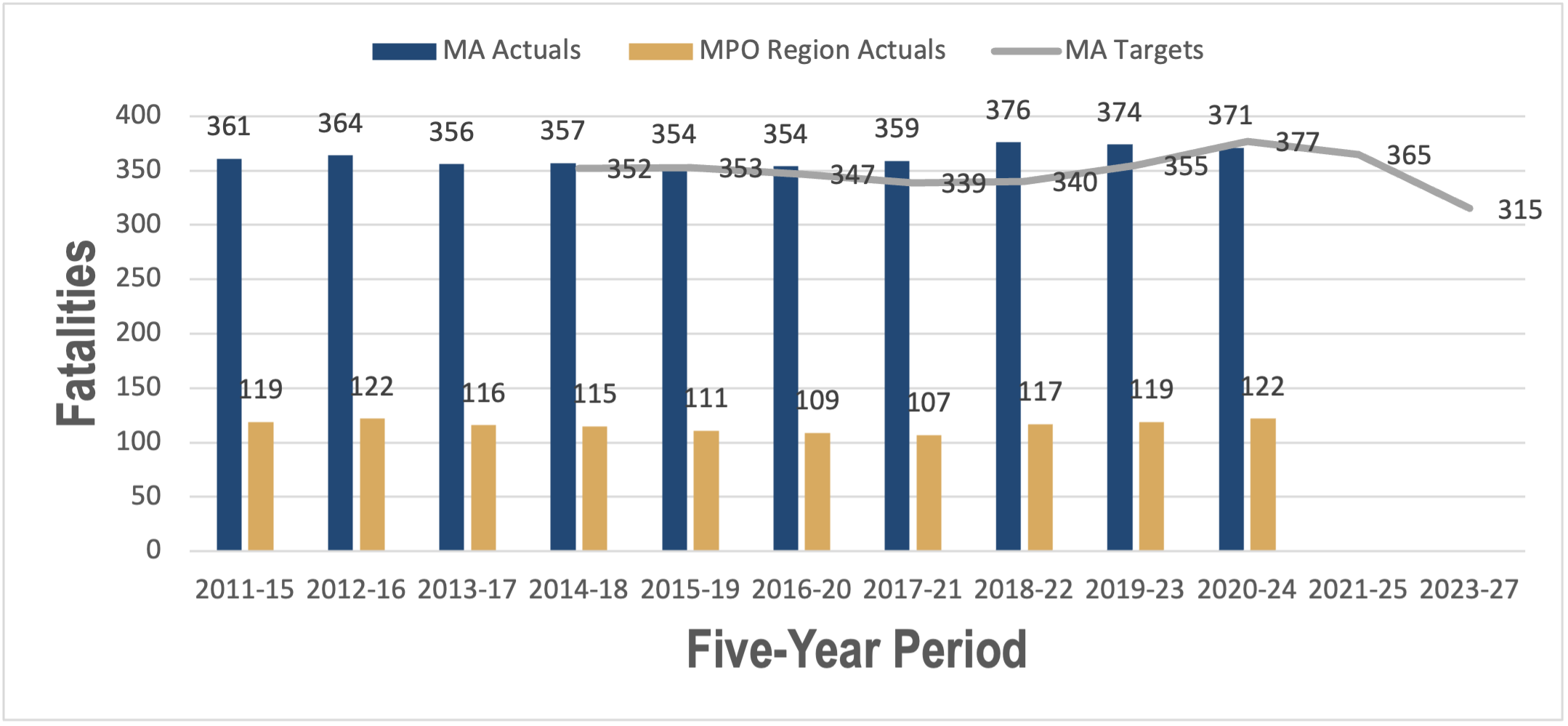
To estimate 2024 fatalities, MassDOT compared data from 2015–23 to the data available at the time of target setting in July 2024. On average, 55 percent of annual fatalities occurred between January 1 and July 30 of each year. Therefore, to estimate 2024 fatalities, MassDOT divided the number to date by 55 percent. A three percent annual reduction in fatalities was then assumed to obtain an estimate for 2025, which brings the 2021–25 five-year rolling average to 365. If this three percent decrease in annual fatalities continues, MassDOT projects the 2023–27 five-year average to be 315.
Although numeric targets have been established following federal guidelines, MassDOT’s overarching goal is zero deaths and this goal will be pursued by implementing strategies from the Strategic Highway Safety Plan (SHSP). The Massachusetts SHSP and Vulnerable Road User Safety Assessment were both updated and finalized in 2023. These strategies help provide details on how the state will decrease fatalities and serious injuries.
Figure 1 shows five-year rolling averages of past state and regional performance on fatalities, as well as the state’s performance targets. The five-year rolling average target for 2021–25 is 365 fatalities.
Figure 1
Total Fatalities, State and MPO Region
MA = Massachusetts.
Sources: Federal Highway Administration, Commonwealth of Massachusetts, and Boston Region MPO Staff.
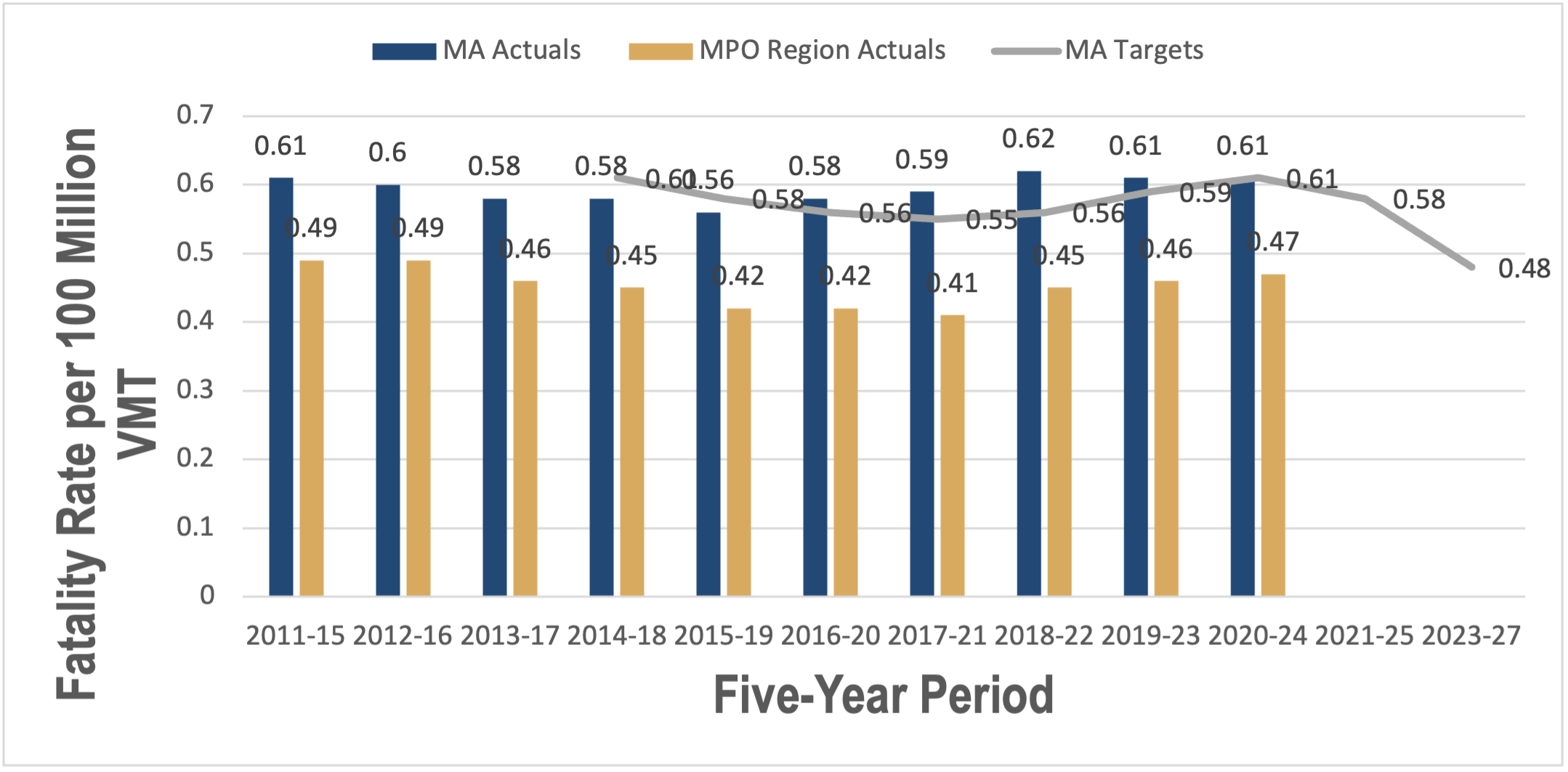
The fatality rate represents five-year average fatalities divided by five-year average VMTs. The COVID-19 pandemic greatly impacted VMT, causing fatality rates to spike in 2020 with significantly lower VMT and slightly higher fatalities. However, VMT in Massachusetts is returning to pre-pandemic levels and annual projections for 2024 are nearly in line with 2019, while 2025 projections are slightly higher. Consequently, the five-year average fatality rate is estimated to be 0.58 fatalities per 100 million VMT for 2021–25. If this trend continues, MassDOT projects a decrease to 0.48 fatalities per 100 million VMT for 2023–27.
Figure 2 shows five-year rolling averages of past state and regional performance on fatality rate, as well as the state’s targets. The five-year rolling average target for 2021–25 is 0.58 fatalities per 100 million VMT.
Figure 2
Fatality Rate, State and MPO Region
MA = Massachusetts. VMT = Vehicle-Miles Traveled.
Sources: Federal Highway Administration, Commonwealth of Massachusetts, and Boston Region MPO Staff.
The target-setting process began with a trend line projection based on the most recent available data. The 2022 and 2023 serious injury data were not finalized in the statewide crash system during this process, so it is possible these figures will change once that data becomes final.
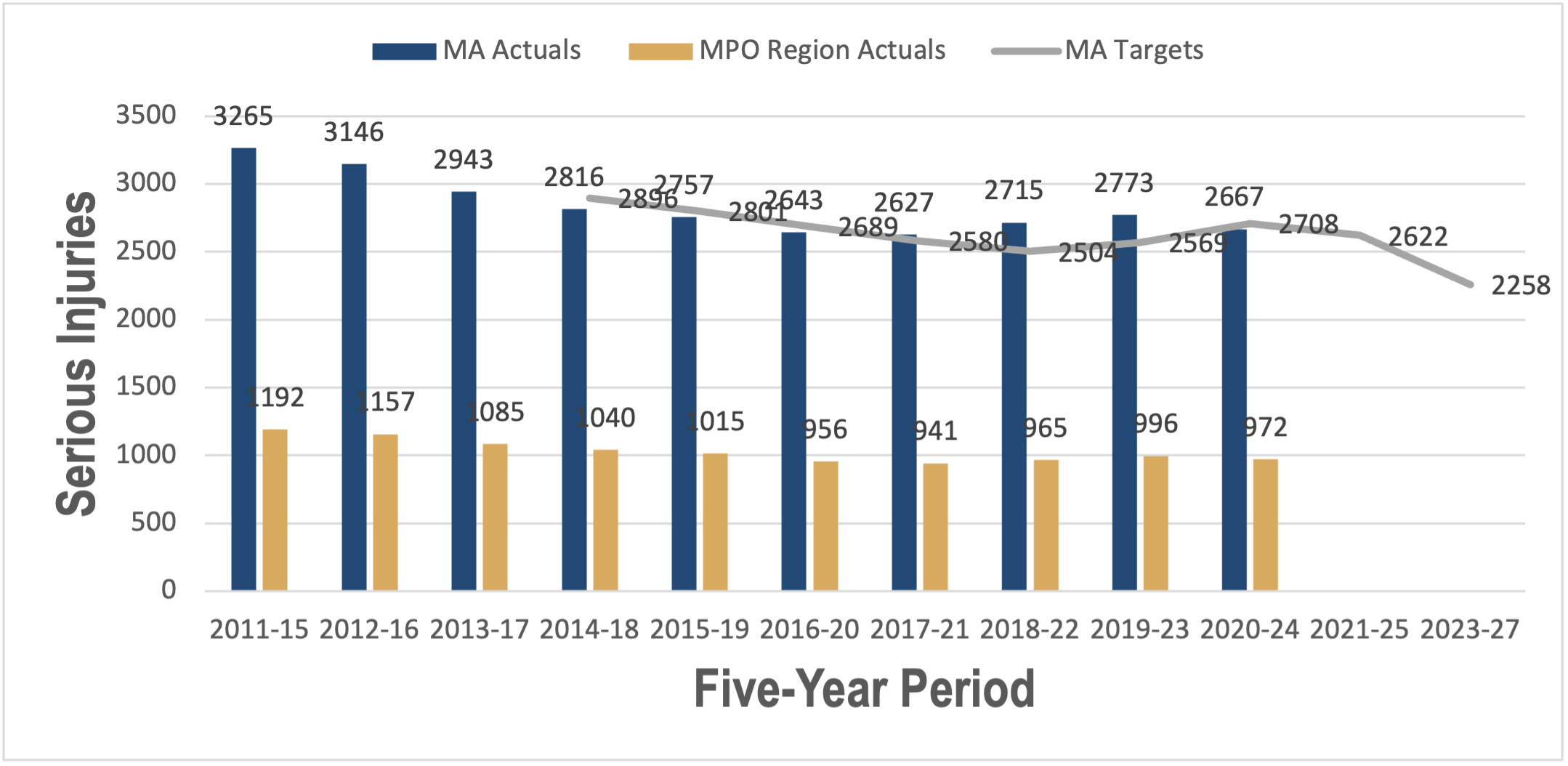
Due to higher rates of speeding caused by decreased VMT amid pandemic shutdowns in 2020 and the lingering impacts into 2021 and 2022, serious injuries increased relative to previous years. However, Massachusetts began to see this trend reverse in 2023. To estimate 2024 serious injuries, MassDOT compared data from 2015–23 to the data available at the time of target setting. The number of serious injuries in 2024 to date were divided by 55 percent, the average of serious injuries that occur between January 1 and July 30 each year. A three percent annual reduction in serious injuries was then assumed to obtain an estimate for 2025, which brings the 2021–25 five-year rolling average to 2,622. If this three percent annual decrease continues, the 2023–27 five-year average of serious injuries will be 2,258.
Figure 3 shows five-year rolling averages of past state and regional performance on serious injuries, as well as the state’s targets. The five-year rolling average target for 2021–25 is 2,622 serious injuries.
Figure 3
Total Serious Injuries, State and MPO Region
MA = Massachusetts.
Sources: Federal Highway Administration, Commonwealth of Massachusetts, and Boston Region MPO Staff.
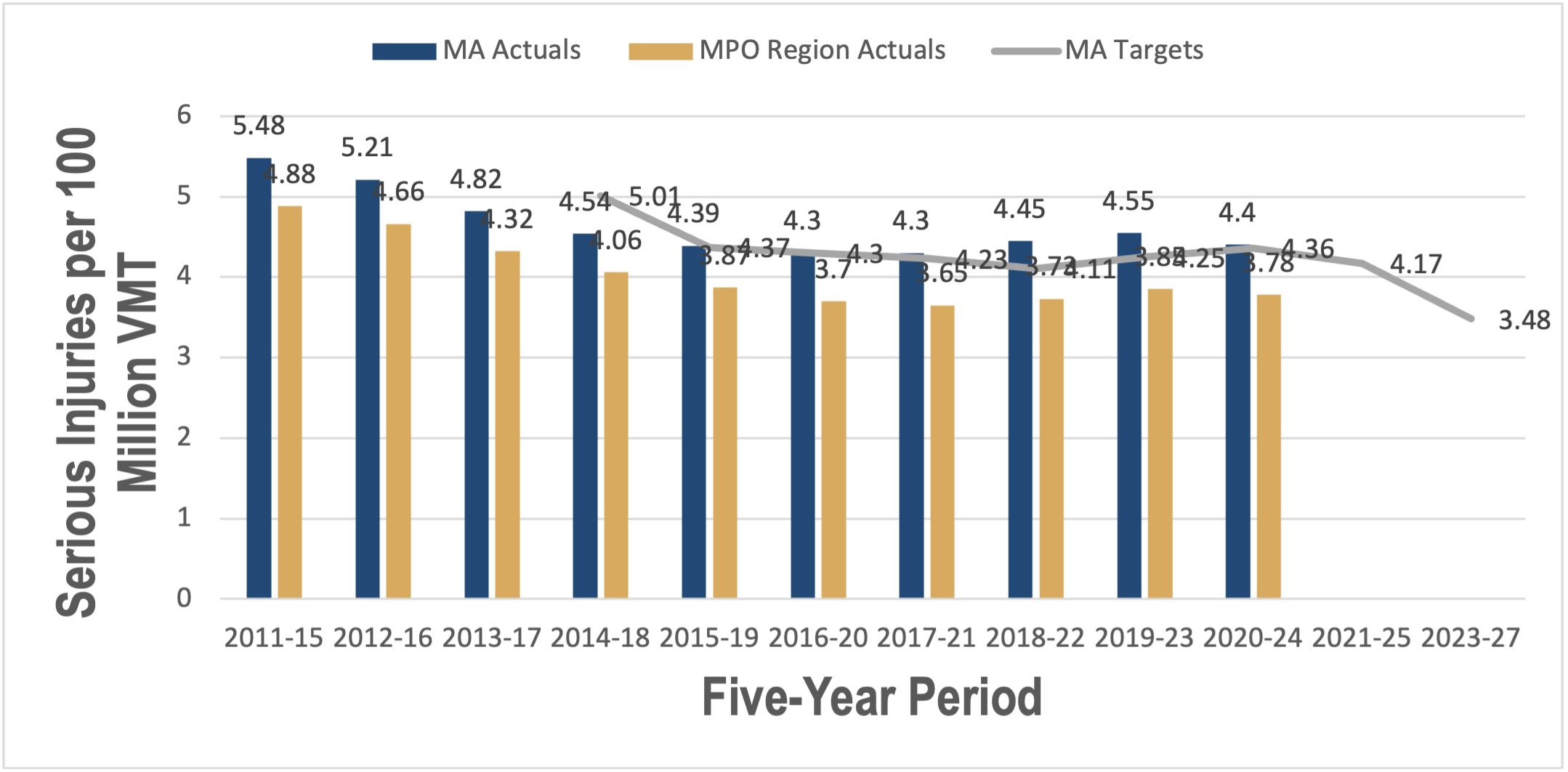
Similar to the fatality rate, the rate of serious injuries is trending toward pre-pandemic levels. Following the same methods to derive the five-year average fatality rate, the five-year average serious injuries rate is estimated to be 4.17 serious injuries per 100 million VMT for 2021–25. If this trend continues, MassDOT projects a decrease to 3.48 serious injuries per 100 million VMT for 2023–27.
Figure 4 shows five-year rolling averages of past state and regional performance on serious injury rate, as well as the state’s targets. The five-year rolling average target for 2021–25 is 4.17 serious injuries per 100 million VMT.
Figure 4
Serious Injury Rate, State and MPO Region
MA = Massachusetts. VMT = Vehicle-Miles Traveled.
Sources: Federal Highway Administration, Commonwealth of Massachusetts, and Boston Region MPO Staff.
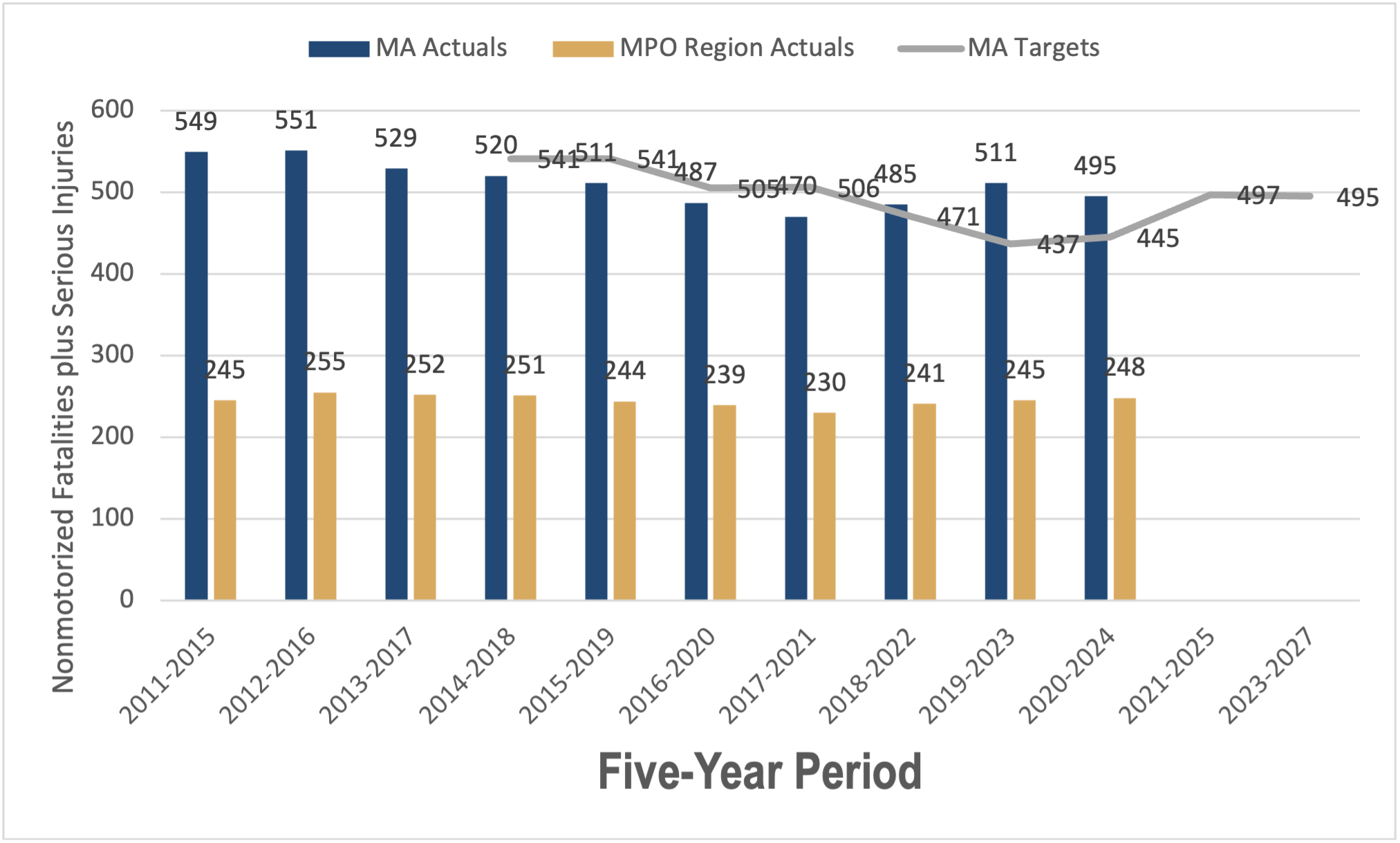
The number of nonmotorized fatalities and serious injuries has fluctuated greatly in recent years. Nonmotorized fatalities, specifically, increased through 2022 and then dropped precipitously, while serious injuries appear to have peaked in 2023 and show signs of decreasing in 2024. On average, 54 percent of annual nonmotorized fatalities and serious injuries occur between January 1 and July 30. Therefore, to estimate 2024 fatalities, MassDOT divided the number to date by 54 percent. Based on the state’s increased work and emphasis to protect vulnerable road users, a five percent annual reduction in nonmotorized fatalities and serious injuries was then assumed to obtain an estimate for 2025, which brings the 2021–25 five-year rolling average to 497. If this five percent annual decrease continues, MassDOT projects the 2023–27 five-year average to be 445.
Figure 5 shows five-year rolling averages of past state and regional performance on nonmotorized fatalities plus nonmotorized serious injuries, as well as the state’s targets. The five-year rolling average target for 2021–25 is 497 nonmotorized fatalities and serious injuries.
Figure 5
Nonmotorized Fatalities and Serious Injuries, State and MPO Region
MA = Massachusetts.
Sources: Federal Highway Administration, Commonwealth of Massachusetts, and Boston Region MPO Staff.
While the rolling averages of nonmotorized fatalities and serious injuries have been trending downward for a decade statewide, on an annual basis, nonmotorized fatalities and serious injuries have varied from year to year. In some individual years, the trend for nonmotorized fatalities has moved in the opposite direction of nonmotorized serious injuries, which is not captured in Figure 5.
Note: The fatality and serious injury data contained here was developed to align with the data included in MassDOT's annual Highway Safety Improvement Program report. As such, historical data may be different from what was reported in prior years.
The targets were developed in coordination with the Executive Office of Public Safety and Security, the Highway Safety Division, and other sections within MassDOT. Although MassDOT emphasizes that the state’s goal is zero fatalities and serious injuries, the state targets presented here are not “goals” but realistic targets considering the events of the last several years. The Secretary of Transportation and Highway Division Administrator for MassDOT approved the targets, recognizing that MassDOT must demonstrate short-term incremental steps to achieve the Commonwealth’s goal.