Alicia Wilson
Pam Wolfe
Mary McShane
Paul Reim
Jane Gillis
Jane Gillis
The preparation of this document was supported by the Federal Highway Administration through
MassDOT 3CPL contract #78890 and the Federal Transit Administration through MassDOT 5303 contract #78922.
Central Transportation Planning Staff Directed by the Boston Region Metropolitan
Planning Organization. The MPO is composed of state and regional agencies and authorities, and local governments.
June 19, 2014

To request additional copies of this document or copies in an accessible format, contact:
Central Transportation Planning Staff State Transportation Building
Ten Park Plaza, Suite 2150 Boston, Massachusetts 02116
(617) 973-7100
(617) 973-8855 (fax)
(617) 973-7089 (TTY)
Title VI of the Civil Rights Act of 1964 (42 United States Code (USC) §2000d) provides that “no person in the United States shall, on the grounds of race, color, or national origin, be excluded from participation in, be denied the benefits of, or be subject to discrimination under any program or activity receiving federal financial assistance.” To fulfill this basic civil rights mandate, each federal agency that provides financial assistance for any program is authorized and directed by the United States Department of Justice to apply provisions of Title VI to each program by issuing applicable rules, regulations, or requirements. As federal agencies, the Federal Transit Administration (FTA) and the Federal Highway Administration (FHWA) require that funding recipients have Title VI programs and document their programs and activities.
As a subrecipient of funding from both FTA and FHWA, the Boston Region Metropolitan Planning Organization (MPO) has prepared this report that explains its Title VI program. The program, conducted in cooperation with the Massachusetts Department of Transportation (MassDOT), is consistent with the principles of Title VI, federal guidelines, and related requirements and is responsive to the needs of Title VI beneficiaries.
Title VI of the Civil Rights Act of 1964 (42 United States Code (USC) §2000d) provides that “no person in the United States shall, on the grounds of race, color, or national origin, be excluded from participation in, be denied the benefits of, or be subject to discrimination under any program or activity receiving federal financial assistance.” To fulfill this basic civil rights mandate, each federal agency that provides financial assistance for any program is authorized and directed by the United States Department of Justice to apply provisions of Title VI to each program by issuing applicable rules, regulations, or requirements. The Federal Transit Administration (FTA) of the United States Department of Transportation issued guidelines on May 26, 1988, FTA C 4702.1, describing the contents of Title VI compliance programs to be adopted and maintained by recipients of FTA- administered funds for transit programs. The latest FTA guidance, FTA C 4702.1B, was issued on October 1, 2012.
The Federal Highway Administration (FHWA) issued guidance in U S Code Title 23, Section 200 on April 1, 2011 and updated it on April 1, 2013.
Although Title VI is the focal point of nondiscrimination law in this country, FHWA incorporates a broader application of nondiscrimination statutes, regulations, and Executive Orders into its Title VI program requirements for states and their subrecipients. For example, Section 324 of the Federal-Aid Highway Act of 1973 prohibits discrimination based on sex; Section 504 of the Rehabilitation Act of 1973 prohibits discrimination on the basis of disability status, as does the Americans with Disabilities Act of 1990; and the Age Discrimination Act of 1975 prohibits age discrimination. In addition, the Civil Rights Restoration Act of 1987 (FHWA Notice 4720.6) clarified the original intent of Congress with respect to Title VI by restoring the broad, institution-wide scope and coverage of the nondiscrimination statutes to include all programs and activities of federal-aid recipients, whether or not such programs and activities are federally assisted; and it enforced application of the laws that include nondiscrimination on the basis of race, color, national origin, age, gender, or disability.
In addition, the principles of Executive Order 13166 on limited English proficiency (LEP) are incorporated to ensure that meaningful access is provided to persons who are not proficient in the English language. This guidance is based on the prohibition against national origin discrimination in Title VI of the Civil Rights Act of 1964, as it affects the LEP population.
This document explains the Boston Region MPO’s Title VI program, which— conducted in cooperation with the Massachusetts Department of Transportation (MassDOT)—is consistent with the principles of Title VI, federal guidelines, and related requirements, and is responsive to the needs of Title VI beneficiaries.
Chapter 2 of this report addresses the MPO’s general reporting requirements under the circular including FTA and FHWA certifications and assurances; certification that the MPO as a body has approved this document; the MPO’s notice to the public regarding Title VI protections; a description of the procedures for filing civil rights complaints; a list of Title VI discrimination complaints, investigations and lawsuits; and the MPO’s plan to provide meaningful access to persons with limited English proficiency. Chapter 3 describes the MPO’s public outreach and public participation activities and highlights how the MPO reaches out to minority, LEP, and low-income populations. Chapter 4 provides an assessment of the MPO’s planning process, a demographic profile of the MPO region, and a description of the strategies used to identify the needs of minority and low-income residents.
The MPO’s Title VI assurances for federal fiscal year 2014 are cited beginning on page 9 of this report. Please note that the text of these assurances is not accessible to individuals with low or no vision who use a screen reader.
FTA Fiscal Year 2014 Certification and Assurances
Title 49 CFR Section 21.9(d) requires recipients to provide information to the public regarding the recipient’s obligations under the United States Department of Transportation’s (US DOT) Title VI regulations and apprise members of the public of the protections against discrimination afforded to them by Title VI. The MPO notice, adapted from a MassDOT prototype, follows:
The Boston Region Metropolitan Planning Organization (MPO) operates its programs, services, and activities in compliance with federal nondiscrimination laws including Title VI of the Civil Rights Act of 1964 (Title VI), the Civil Rights Restoration Act of 1987, and related statutes and regulations. Title VI prohibits discrimination in federally assisted programs and requires that no person in the United States of America shall, on the grounds of race, color, or national origin (including limited English proficiency), be excluded from participation in, be denied the benefits of, or be otherwise subjected to discrimination under any program or activity receiving federal assistance. Related federal nondiscrimination laws administrated by the Federal Highway Administration, the Federal Transit Administration, or both prohibit discrimination on the basis of age, sex, and disability. These protected categories are contemplated within the Boston Region MPO’s Title VI Program consistent with federal interpretation and administration. Additionally, the Boston Region MPO provides meaningful access to its programs, services, and activities to individuals with limited English proficiency, in compliance with US Department of Transportation policy and guidance on federal Executive Order 13166.
The Boston Region MPO also complies with the Massachusetts Public Accommodation Law, M.G.L. c 272 §§ 92a, 98, 98a, prohibiting making any distinction, discrimination, or restriction in admission to or treatment in a place of public accommodation based on race, color, religious creed, national origin, sex, sexual orientation, disability, or ancestry. Likewise, the Boston Region MPO complies with the Governor's Executive Order 526, section 4 requiring all programs, activities, and services provided, performed, licensed, chartered, funded, regulated, or contracted for by the state shall be conducted without unlawful discrimination based on race, color, age, gender, ethnicity, sexual orientation, gender identity or expression, religion, creed, ancestry, national origin, disability, veteran's status (including Vietnam-era veterans), or background.
To request additional information regarding Title VI and related federal and state nondiscrimination obligations, please contact:
Title VI Specialist - Boston Region MPO
10 Park Plaza, Suite 2150
Boston, MA 02116
617-973-7100
TTY: 617-973-7089
To file a complaint alleging a violation of Title VI or related federal nondiscrimination law, contact the Title VI Specialist (above) within 180 days of the alleged discriminatory conduct. To file a complaint alleging a violation of the state's Public Accommodation Law, contact the Massachusetts Commission Against Discrimination within 300 days of the alleged discriminatory conduct at:
Massachusetts Commission Against Discrimination (MCAD) One Ashburton Place, 6th Floor
Boston, MA 02109
617-994-6000
TTY: 617-994-6196
English: If this information is needed in another language, please contact the Boston Region MPO’s Title VI Specialist at 617-973-7100.
(The above phrase will be repeated in four additional languages.)
Once MassDOT completes the translations, this statement will be posted on the MPO’s website along with the procedures for filing a complaint described in Appendix A of this report. This notice also will be posted at the entrance to the MPO office and a shorter version will be included in all public-outreach materials and on MPO meeting agendas. (A different version of this notice is currently posted on the MPO website, on outreach materials and MPO meeting agendas.)
In order to comply with both FTA and FHWA requirements, the MPO has developed procedures for receiving, investigating, addressing, and tracking Title VI complaints, which are included in Appendix A. MassDOT is in the process of revising its complaint procedures. The MPO will adopt these procedures when they are finalized.
The MPO has not been the recipient of any Title VI complaints or lawsuits as defined by the Department of Justice and FTA, and no investigations have been initiated. However, FHWA includes those with disabilities as a protected class in its Title VI nondiscrimination definition. The following is pertinent information concerning an ADA complaint.
Date Filed with FHWA |
Summary of Allegations |
Status |
Findings |
March 28, 2012 |
MPO did not provide an auxiliary hearing aid; failed to address attitudinal issues regarding people with disabilities; failed to train staff; failed to provide an effective alternative accommodation; retaliated against complainants. |
Closed |
The Boston MPO did not violate the ADA and Section 504 by failing to provide reasonable accommodations for persons with disabilities. |
It is the policy of the MPO that people with limited English proficiency be neither discriminated against nor denied meaningful access to and participation in the programs and services provided by the MPO. The MPO has developed a Language Assistance Plan (LAP) to be sure that it employs appropriate strategies in assessing needs for language services and in implementing language services that provide meaningful access to the planning process and to published information without placing undue burdens on the MPO’s resources.
The LAP, included in Appendix B, will be reviewed and revised periodically based on demographic changes, changes in the frequency of encounters with LEP persons, feedback from LEP groups, and changes in technology.
The MPO facilitates and encourages the involvement of minority, low-income, elderly, persons with disabilities, and LEP persons in its activities. As described in this chapter, it reaches out to these populations through its Public Participation Program (including its process for developing the metropolitan transportation certification documents), its Transportation Equity Program, its Coordinated Public Transit-Human Services Transportation planning, and the Access Advisory Committee to the MBTA.
The MPO utilizes a variety of approaches to providing for communication and consultation with interested parties and members of the public and is continually working to improve its outreach. This section will summarize the activities conducted and the outreach methods used by the MPO in implementing its public participation program. The MPO has recently updated its public participation plan (the Plan)—which describes all of the activities in its public participation program (the Program)—to be consistent with MassDOT’s plan, particularly regarding Title VI requirements. The Plan was revised following public outreach and research on MPO public participation needs and desires. The plan will be adopted in the fall, subsequent to a public-comment period on the draft and any changes that may need to be made as a result. The Draft Public Participation Plan is included in Appendix C.
The MPO conducts a varied and ongoing program for gathering information and views from all sectors of the public for its transportation planning and programming work. Some activities are focused specifically on the development of the certification documents. Others are ongoing and provide input year-round. All activities are open to the public and all MPO-sponsored activities are held at locations accessible for people with disabilities. The locations are well dispersed through the region, include environmental justice communities, and are almost always served by public transportation. In conducting its activities, the MPO strives to meet the needs of people requiring special services such as translation for LEP populations, American Sign Language interpreters, large-format printed materials, audiotapes, Braille materials, and escorts. Meeting materials are available in accessible formats and in other languages, upon request. Assistive- listening devices and microphones are provided at all public meetings.
Listed below are MPO activities that provide opportunities for the public to learn about metropolitan transportation planning and programming processes and provide input to decision making.
MPO outreach methods generally serve either or both of two purposes: 1) notification, and 2) provision of informational materials and reports. The MPO works to maintain state-of-the-practice capabilities in its methods.
Certification documents, other reports, informational materials, and notices are obtainable upon request in varied formats, including, Braille, and large-print. All documents are posted on the MPO website in PDF and HTML to provide accessibility for persons with disabilities. Members of the public may request meeting materials, in standard or accessible formats, by email, telephone, fax, or via US mail.
The MPO provides public notifications in a variety of ways, such as the MPO web site, news flashes, press releases for regional and local newspapers, and e- mailing flyers and notices in English, Spanish, Chinese, and Portuguese, to local officials, regional equity contacts, and other interested parties. The MPO’s newsletter, TRANSREPORT, publishes notices and discusses issues.
Organizations providing support for persons with disabilities also forward MPO notices to their constituents in accessible formats.
Notices also are distributed via the MPO’s one-way listserve, “MPOinfo,” or the email groups of the MPO, Advisory Council, Transportation Equity Program, TIP contacts, and AACT members. MPOinfo has approximately 2,800 contacts and includes local officials, legislators, transit-service providers, councils on aging, chambers of commerce, regional employment boards, community development corporations, other social service organizations, members of the public who have attended meetings, and all other interested parties. Examples of MPO notices are included in Appendix E.
The MPO’s website posts notices of public outreach events and current activities and is an important method for distributing information to everyone with Internet access. It is a broad-based resource for people interested in MPO activities, notices, meeting minutes (including those of the MPO and the Advisory Council), reports, documents, and studies. It also hosts extensive transportation data about the region and other transportation planning information. Website users are invited to submit comments electronically through the “Meetings and Input” button on the homepage, the public participation page, and on each certification document’s page. The MPO also uses its web-based surveys to gather input on recent public outreach. A summary of outreach efforts is included in Appendix F.
The website is accessible to people who are visually impaired. MPO-produced documents use accessible fonts and formats that can be read by screen readers. The web site is equipped with Google Translates, software that translates posted text into many languages, including those most frequently spoken in the region. Vital documents are formally translated into Spanish, Chinese, and Portuguese and posted on the website. Documents currently defined as vital include:
The MPO’s bi-monthly newsletter, TRANSREPORT, provides information on the MPO planning process. Every issue reports on upcoming transportation-related public meetings and events, MPO activities, MPO and agency studies, and how to contact MPO staff with ideas, questions, and comments. Occasionally, issues include postage-paid survey inserts asking for input and ideas. TRANSREPORT is sent by mail and electronically to nearly 3,000 recipients. Issues are posted on the MPO website each month and later archived.
The MPO has an established process for considering the transportation needs and views of underserved constituencies, including communities of low-income, LEP, and minority residents. The MPO developed its Transportation Equity Program in order to have a systematic method of considering environmental justice in all of its transportation planning work. The program builds on the foundation of ongoing outreach concerning transportation needs and previous analyses of accessibility and mobility for low-income and minority communities in the Boston region. The findings from this work have been incorporated in the development of a number of MPO documents, including the 2010–2035 Long- Range Transportation Plan (LRTP), the 2000–2025 LRTP Addendum and Update, the 2004–2025 LRTP, the 2007–2030 LRTP (JOURNEY to 2030), the current LRTP (Paths to a Sustainable Region), and current Transportation Improvement Programs (TIPs) and Unified Planning Work Programs (UPWPs).
The MPO has adopted the following environmental justice policy, which it commits to:
The MPO’s Transportation Equity Program is composed of three key elements: community outreach, incorporation of environmental justice in the planning process, and analysis of the effects of planned transportation projects.
The MPO takes a proactive, grassroots approach to identifying and articulating environmental justice issues in the region. Methods include:
In carrying out these methods, the MPO has identified social service and community contacts involved in and knowledgeable about the transportation needs of environmental justice populations. These contacts include social service organizations, cultural and ethnic organizations, community development corporations, regional employment boards, civic groups, business and labor organizations, transportation advocates, environmental groups, councils on aging, independent living facilities, veteran’s organizations, and environmental justice/civil rights groups. The MPO is currently taking active steps to increase the number of contacts in its transportation equity outreach database.
Information about the transportation needs of minority, LEP, and low-income populations is primarily collected through one-on-one and small-group interviews and meetings with community contacts, surveys, and larger MPO focus groups or forums.
MPO staff seek to initiate interviews at the offices of representatives of community organizations to discuss transportation needs and burdens. In this way, the MPO facilitates the participation of some of the people best positioned to speak about the transportation needs of environmental justice areas, who might not otherwise have the time or financial resources to travel to meetings in a central location or to participate in public forums.
During these meetings, the MPO is able to both obtain information about the transportation needs of the area and inform participants about the MPO and the metropolitan planning process. Information and surveys are mailed to community contacts prior to these meetings to help participants prepare. These materials are also sent to those who are unable to schedule time for an interview.
A transportation equity survey is posted on the MPO website to help individuals identify transportation needs and problems in their communities. An “Invitation to Participate” (see Appendix G) along with the survey were sent to all of the transportation equity contacts. Comments obtained from the online survey are summarized and forwarded to appropriate agencies and communities. The MPO will continue this initiative and conduct additional surveys periodically.
Communication is ongoing, as MPO staff keep community organizations updated with information concerning MPO planning activities and continue to solicit information and views. The MPO also encourages contacts to participate in all scheduled MPO meetings and forums.
MPO staff interpret, summarize, and classify the needs identified by each participant in the outreach process as related to the LRTP, the TIP, the UPWP, service planning, and other planning processes. This information has been compiled and used as input to MPO work.
The MPO continues to consult with community partners involved in the MPO transportation equity process by providing a written summary of staff’s explanation of their needs for their review. They are informed of which classification(s) each of their needs has been given: LRTP, TIP, UPWP, service planning, or other. Communication is ongoing, as the MPO staff keep community partners updated with information. A summary of current and planned MPO activities (including MPO-sponsored meetings or meetings sponsored by other agencies, if known) that are related to the community’s needs may also be included.
The MPO will continue to expand its outreach to neighborhoods of concern and broaden its direct contacts with minority, LEP, elderly, and low-income residents in these communities. The goal is to identify specific community needs and to facilitate answers and possible actions by responsible agencies. Assistance in reaching some solutions will involve coordination with the Operations and Service Planning departments of the MBTA and the Office of Transportation Planning at MassDOT.
The MPO—in partnership with MAPC, the Human Service Transportation Office of the Executive Office of Health and Human Services, and the Statewide Mobility Manager (MassDOT Rail and Transit Division)—convened a Human Services and Equity in Transportation Forum in January 2014 to promote transportation services for populations who historically have had problems accessing, paying for, or receiving transportation that meets all of their trip- making needs. The target populations included seniors, minorities, people with low incomes, people with disabilities, those with limited English proficiency, veterans, and/or people living in zero-vehicle households in the MPO region.
Approximately 70 people representing individuals and diverse groups, some of whom were new to public participation, attended the forum. The forum prospectus and invitation are included in Appendix H.
The MPO’s current Coordinated Public Transit Human-Services Transportation Plan (CHST Plan) provides guidance for improving transportation services for people with disabilities, elderly individuals, people with low incomes, and reverse- commuters in the Boston region; and it facilitates the coordination of public transit and human-services transportation resources. The original plan, completed in 2008 and updated in 2010, was developed in accordance with SAFETEA-LU, the federal legislation that funded surface transportation during that time period. The legislation established that recipients of funding from any of three Federal Transit Administration human-services transportation programs—Section 5310, for Elderly Individuals and Individuals with Disabilities, Section 5316, Job Access and Reverse Commute (JARC), and Section 5317, New Freedom (projects for individuals with disabilities that go beyond ADA requirements)—must certify that the projects to be funded have been selected from a locally developed, coordinated public transit–human services transportation plan, such as the CHST Plan. Section 5316 and Section 5317 grant programs were eliminated under MAP-21, the current surface transportation act, and the plan will be updated to reflect this. Information obtained from the forum mentioned above and from ongoing outreach and staff inventory of transit services also will be used to update the plan.
The Access Advisory Committee to the MBTA (AACT) is a consumer advocacy organization composed primarily of people with disabilities, seniors, and representatives of human service agencies. The MPO funds staff support for AACT. Working closely with the MBTA, AACT strives to ensure that the transportation system of the Boston region is accessible, in addition to being safe and efficient, as guaranteed by the Americans with Disabilities Act (ADA). AACT meets once a month to coordinate with MBTA officials and paratransit operators, to identify accessibility problems in the system, and to work on solutions. All meetings are open to the public. MPO staff coordinate the activities of AACT and notify AACT members of opportunities to participate in MPO planning.
The Regional Transportation Advisory Council (Advisory Council) is an independent group charged with providing public input on transportation planning to the Boston Region MPO. As a voting member of the MPO, the Advisory Council brings the perspectives of the public to the MPO for consideration as plans and programs are developed. Individuals are welcome to participate in all meetings of the Advisory Council, but membership is limited to public and private organizations and governmental units, including state agencies and municipalities. Entities are admitted to membership by vote of the existing members.
The Advisory Council is conducting outreach to make the membership more diverse. Agencies representing environmental-justice populations are offered an opportunity to participate in the Advisory Council during Transportation Equity outreach. This additional outreach to agencies has met with some success.
The MPO provides for non-discrimination in transit planning and programming through oversight and representation by its members; by following federal legislation and the 3C (continuing, cooperative, and comprehensive) transportation planning process; by reflecting the legislation in its objectives,policies, and plans; and by having non-discriminatory development and implementation processes for its LRTP, TIP, and UPWP.
Transportation equity/environmental justice is an integral part of the MPO transportation planning process. MPO policy promotes equitable sharing of the region’s transportation system benefits and burdens as well as participation in decision making. In 2010, the MPO adopted seven visions, each with an associated policy, that guide its planning processes. Two of the visions and their policies explain MPO’s commitment to promoting equity and accessibility for all:
These policies were applied in assessing projects for inclusion in the LRTP, in developing MPO criteria for evaluation and selection of projects for the TIP; in selecting and defining studies for the UPWP, which includes MPO staff support for the MBTA’s Title VI reporting work; and in supporting the MPO’s ongoing transportation equity/environmental justice program.
The MPO is currently updating and recasting its visions and policies as goals and objectives with quantifiable targets to reflect national goals for performance- based decision making under MAP-21.
The 3C process in the Boston region is the responsibility of the MPO, which has established the following objectives for the process:
The MPO is responsible for carrying out and completing all transportation plans, programs, and conformity determinations required by federal and state laws and regulations through the 3C process. This includes preparation of the major certification documents: the LRTP, the UPWP, the TIP, and all required air quality analysis. The MPO also initiates studies to identify transportation needs and solutions, and programs financial resources for the region’s multimodal transportation system. The following is a brief description of each of the certification documents:
For planning purposes, it is essential to understand who lives in the MPO region. Entities that receive federal funds are required to develop and use demographic profiles to ensure that the rights of people protected under various civil rights laws and presidential executive orders are not ignored during planning, selection, and implementation of various projects and services.
The FTA’s Title VI and environmental-justice circulars (FTA C4702.1B and FTA C 4703.1, respectively) require demographic profiles of the area encompassed by the MPO. The MPO uses these demographic data for several purposes: to identify geographic areas where minority populations exceed the MPO average; identify LEP populations, for the purpose of ascertaining potential transportation project benefits and burdens on low-income and minority populations, help evaluate TIP projects, and conduct outreach to engage low-income, minority, and LEP populations in the MPO planning process.
Except where otherwise noted, the following demographic profile was developed in 2012, based on the 2010 Census and the 2006-2010 American Community Survey (ACS).
The Boston Region MPO has defined and continues to define a low-income threshold for an individual as a person living in a household whose median income is 60% or less than the median household income in the MPO area. Research indicates that this is in line with thresholds used by comparable MPOs. According to the 2010 ACS Summary File, the median MPO household income is
$70,829, and the MPO’s low-income threshold is $42,497. This income threshold is used for all of the MPO’s Title VI reporting and for all of the environmental- justice analyses conducted for the LRTP and the TIP.
The Title VI circular defines a predominantly minority area as a geographic area, such as a neighborhood, census tract, or transportation analysis zone (TAZ1 ), where the proportion of minority persons residing in that area exceeds the average proportion of minority persons in the recipient’s service area.2
For Title VI purposes, when identifying benefits and burdens of proposed transportation projects included in its LRTP and when evaluating TIP projects, the MPO has defined a minority TAZ as one whose minority population is greater than the overall MPO region’s average of 27.8%. For transportation equity (environmental justice) outreach purposes, the MPO continues to use the minority threshold of 50% or greater as it focuses on the areas of the MPO region that are most heavily defined as “minority.”
Federal regulations define LEP persons as those for whom English is not the primary language and who have a limited ability to read, write, speak, or understand English. It includes people who reported in the US census that they speak English ‘not well’ or ‘not at all.’ FTA, in its latest Title VI circular, includes those who speak English ‘less than well’ in its LEP definition. As such, FTA’s new definition doubles the number of people who are considered to be LEP.
Analysis reveals that the Boston Region MPO is home to approximately 3.2 million residents, 27.8% of whom are minorities. Table 2 shows the distribution of the population by race and the changes between 2000 and 2010. The total population increased by 3%. This growth is primarily a result of an approximately 34% increase in the minority population. The Asian population, which is the fastest-growing minority population, increased by 46%. The Hispanic population, which can include people in all racial groups, increased by 48%. Figure 1 shows the location of low-income and minority TAZs within the MPO.
Race |
2000 Population |
2010 Population |
Change 2000-10 |
2000 Percent |
2010 Percent |
Change 2000-10 |
White |
2,491,060 |
2,413,522 |
-77,538 |
81.2% |
76.3% |
-3.1% |
Black/African American |
230,357 |
272,318 |
41,961 |
7.5 |
8.6 |
18.2 |
American Indian/Alaska Native |
6,079 |
7,620 |
1,541 |
0.2 |
0.2 |
25.3 |
Asian |
164,170 |
239,629 |
75,459 |
5.4 |
7.6% |
46.0% |
Native Hawaiian and other Pacific Islanders |
1,252 |
1,051 |
201 |
0.0 |
0.0 |
-16.1 |
Other |
98,157 |
142,689 |
44,532 |
3.2 |
4.5 |
45.4 |
Two or More Races |
75,319 |
84,883 |
9,564 |
2.5 |
2.7 |
12.7 |
Total |
3,066,394 |
3,161,712 |
95,318 |
100.0% |
100.0% |
3.1% |
Hispanic |
195,598 |
289,034 |
93,436 |
6.4% |
9.1% |
47.8% |
Minority* |
657,102 |
878,118 |
221,016 |
21.4 |
27.8 |
33.6 |
*Includes Hispanic Caucasians, and all non-white populations.
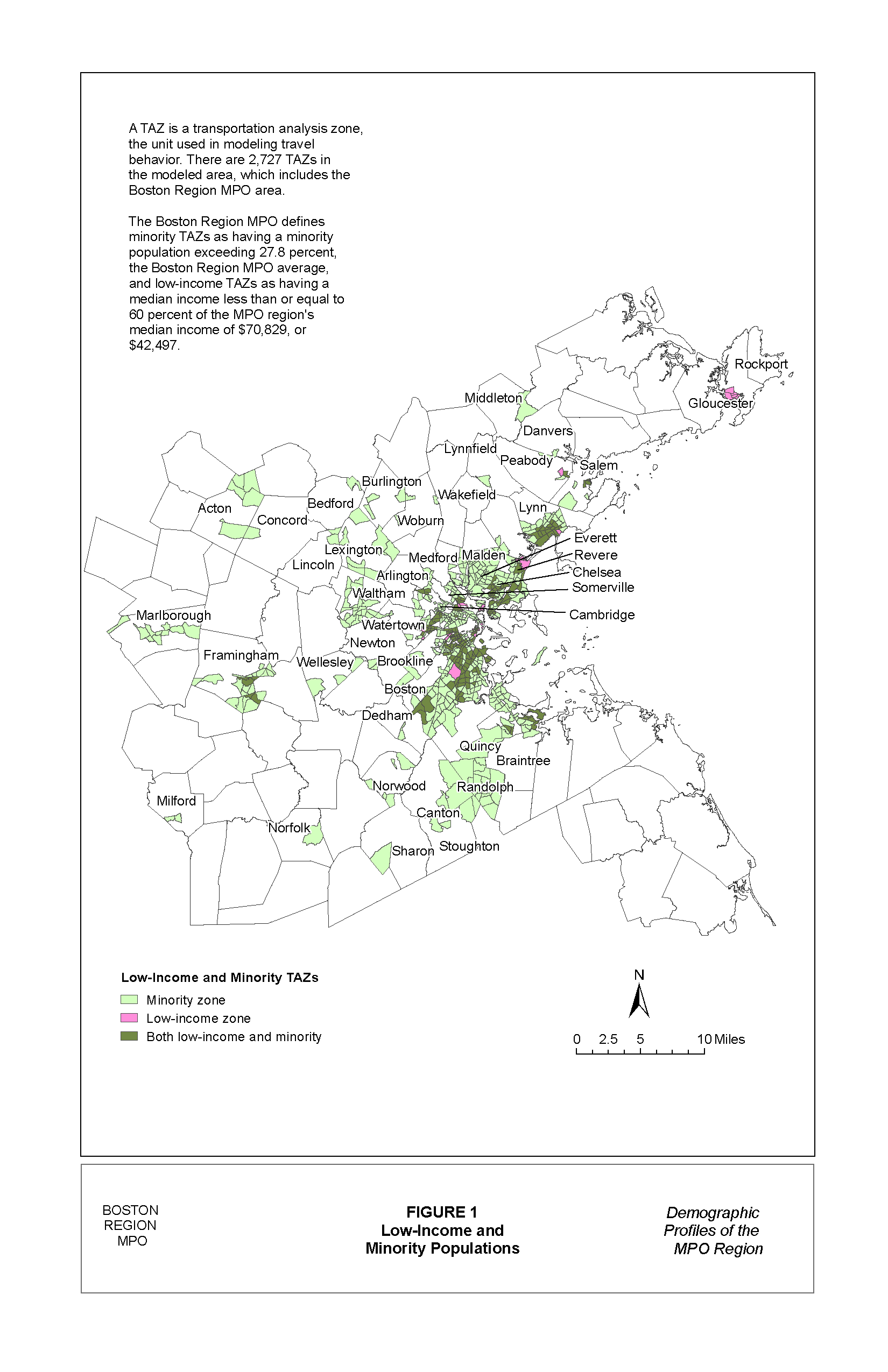
Low-income and minority thresholds were used to identify low-income and/or minority TAZs. (Although Title VI relates to race, color, and national origin, income also is used as a criterion for some Title VI programs.)
The LEP analysis was recently updated using 2012 ACS data. The U S Department of Transportation and FHWA define an LEP person as one who speaks English “not well” or “not at all”. According to the 2012 ACS, 5.3% of the MPO population who are five years of age and older (150,610 of the MPO area population of 2,865,258) are LEP. The largest proportion of LEP persons in the MPO area speak Spanish (39.5%), followed by Chinese (16.1%), and Portuguese (12.7%). Altogether, LEP speakers of these three languages represent over two-thirds (68.3%) of the MPO’s LEP population over five years of age. LEP populations meeting the U. S. Department of Transportation definition of LEP “safe harbor” thresholds (5% of the population or 1,000 individuals, whichever is less) include speakers of the languages shown in Table 3.
Language Spoken* |
Speak English ‘Not Well’ or ‘Not at All’ |
Percent LEP Population |
Percent MPO Population |
Spanish |
57,479 |
39.5% |
2.1% |
Chinese |
24,288 |
16.1 |
0.8 |
Portuguese |
19,167 |
12.7 |
0.7 |
Vietnamese |
9,562 |
6.3 |
0.3 |
French Creole |
8,284 |
5.5 |
0.2 |
Russian |
5,379 |
3.6 |
0.2 |
Italian |
3,151 |
2.6 |
0.1 |
Arabic |
2,717 |
1.8 |
0.1 |
Greek |
2,065 |
1.4 |
0.1 |
Korean |
2,020 |
1.3 |
0.1 |
French |
1,654 |
1.1 |
0.1 |
Mon Khmer, Cambodian |
1,593 |
1.1 |
0.1 |
Albanian |
1,245 |
0.8 |
0.0 |
Other languages |
10,132 |
6.7 |
0.4 |
Total |
150,610 |
100.0% |
5.3% |
*Spoken by the population five years of age and older.
In its current Title VI circular, FTA has broadened the definition of LEP to include individuals who speaks English ‘less than very well’ in addition to those who speak English ‘not at all” and not well.’ This definition doubles the number of LEP individuals in the MPO, although, for the most part, the languages they speak (see Table 4) are the same ones that are identified using the more conservative definition (Table 3).
Language Spoken** |
Speak English ‘Less than Very Well’ |
Percent LEP Population |
Percent MPO Population |
Spanish |
103,147 |
34.2% |
3.6% |
Chinese |
43,614 |
14.4 |
1.5 |
Portuguese |
37,400 |
12.4 |
1.3 |
French Creole |
19,061 |
6.3 |
0.7 |
Vietnamese |
16,186 |
5.4 |
0.6 |
Russian |
12,281 |
4.1 |
0.4 |
Italian |
7,956 |
2.6 |
0.3 |
Arabic |
7,534 |
2.5 |
0.3 |
French |
6,302 |
2.1 |
0.2 |
Korean |
5,296 |
1.8 |
0.2 |
Greek |
4,315 |
1.4 |
0.2 |
Mon-Khmer, Cambodian |
2,915 |
1.0 |
0.1 |
Albanian |
2,888 |
1.0 |
0.1 |
Japanese |
2,416 |
0.8 |
0.1 |
Armenian |
1,856 |
0.6 |
0.1 |
Polish |
1,821 |
0.6 |
0.1 |
Hindi |
1,768 |
0.6 |
0.1 |
Gujarati |
1,607 |
0.5 |
0.1 |
Amharic |
1,402 |
0.5 |
0.0 |
Punjabi |
1,398 |
0.5 |
0.0 |
Persian |
1,247 |
0.4 |
0.0 |
Tamil |
1,140 |
0.4 |
0.0 |
Bengali |
1,076 |
0.4 |
0.0 |
Tagalog |
1,057 |
0.4 |
0.0 |
Other Languages |
16,195 |
5.4 |
0.6 |
Total |
301,878 |
100.0% |
10.5% |
*According to the FTA LEP Definition. **Spoken by the population five years of age and older.
Appendix B, the MPO’s Language Assistance Plan, shows maps with LEP information according to FTA’s LEP definition. The MPO refers to these maps for outreach purposes.
Data supporting the figures will be used for Title VI purposes and to determine benefits and burdens of projects that are included in the MPO’s LRTP and TIP.
The MPO population that is 65 years of age and older is growing slightly faster than the overall population. The general MPO population increased by 3.1% between 2000 and 2010, while the 65-and-older population increased by 4%. Approximately 13.3% of the MPO population belonged to this age group in 2010.
Demographic data are also used to reach out to and inform low-income, minority, and LEP populations about MPO activities and documents. The threshold for defining low-income areas as having a median household income less than or equal to 60% of the MPO’s median household income is used to determine which TAZs are low-income, and this threshold is also used for outreach purposes.
However, as discussed above, for outreach to minority areas, the MPO continues to use the 50% minority threshold as it helps staff to focus its outreach efforts on the most heavily minority areas of the MPO region.
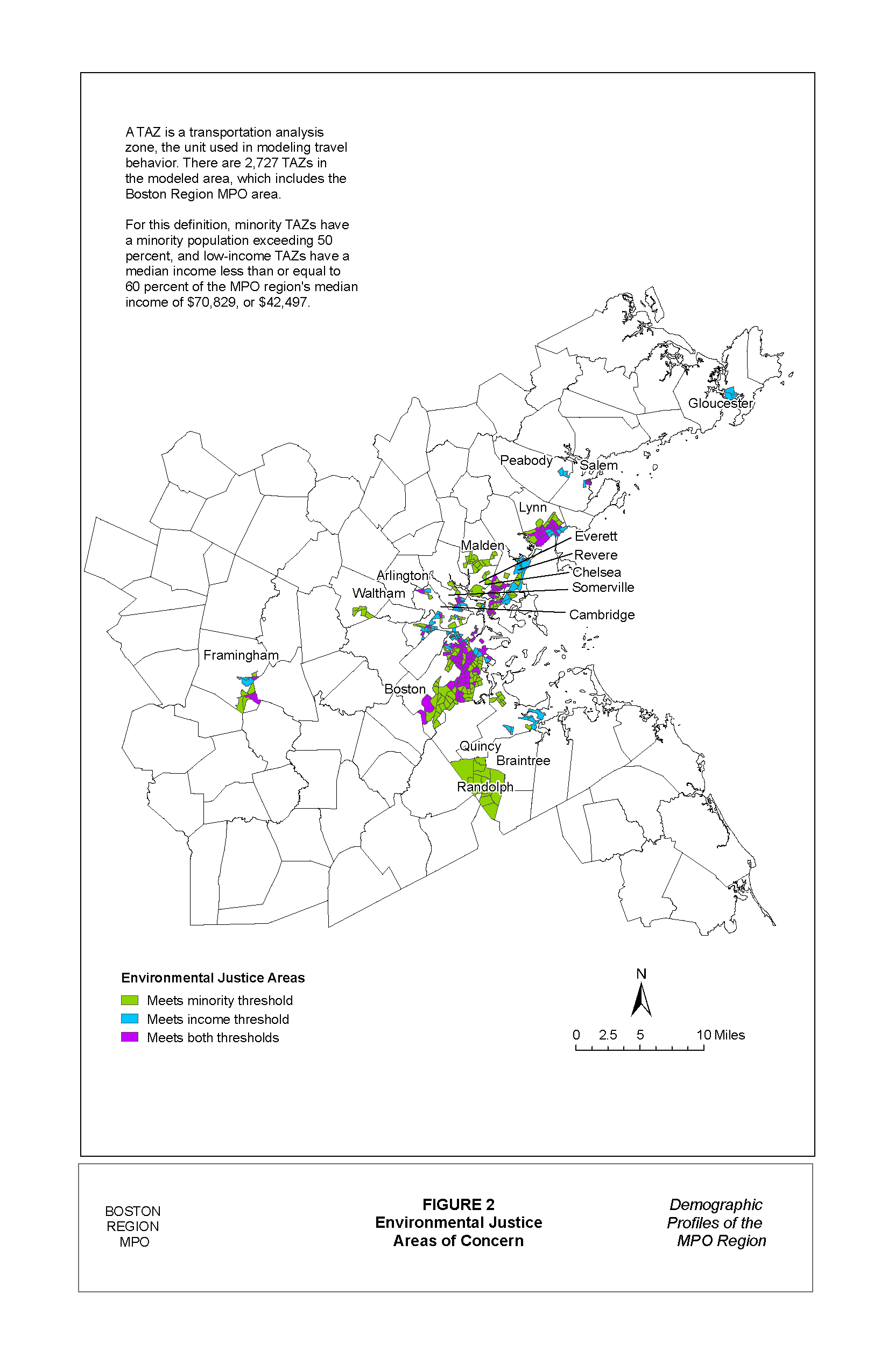
For outreach purposes, the MPO has identified what it calls areas of concern, which are clusters of TAZs that meet the MPO’s income or minority criteria. In general, the TAZs in these clusters have to have at least 200 low-income or minority residents each. TAZs with populations that meet the thresholds and that contain group living quarters with changing populations (for example, prisons and college dorms) but small numbers of households, are excluded.
Analysis indicates that within the MPO region, there are areas of concern in 15 municipalities and 13 Boston neighborhoods. Municipalities containing areas of concern represent 45% of the MPO’s population, 73% of the MPO’s minority population, and 82% of the LEP population (USDOT definition). Identified areas of concern represent 20% of the MPO’s total population, 49% of the minority population, and 54% of the LEP population (USDOT definition). These areas are shown in Figure 2.
The outreach component of the Transportation Equity Program (discussed in Chapter 2) is a major source of information concerning the transportation issues and needs confronting low-income, LEP, and minority residents in the MPO region. MPO staff interpret the needs identified by each community and classify them as related to the LRTP, the TIP, the UPWP, service planning, or another planning process. The LRTP-related needs are a focus of the LRTP needs assessment. The TIP-related needs are identified in the TIP project information forms and in the TIP itself, and they inform the “community impacts” criteria category in the TIP ratings matrix. The UPWP-related needs are considered by the MPO staff and the MPO’s UPWP Subcommittee to inform decisions about possible new MPO studies. Transit service planning needs are forwarded to the MBTA for consideration during development of its biennial service plan. Other needs are referred to appropriate entities.
Additional information about the transportation needs of minority, LEP, low- income, elderly, and persons with disabilities is collected in the MPO’s general public-participation program and its Coordinated Human-Services Transportation planning. This information is integrated with the findings of the transportation equity outreach, and it is used to inform MPO planning activities.
The potential impact of a proposed project in environmental justice areas is considered in the Plan, TIP, and UPWP project-ranking processes.
Environmental justice analyses for the Plan and TIP are funded in the UPWP. In these analyses, MPO staff give projects positive or negative ratings on environmental justice criteria based on the estimated benefit or burden to environmental justice areas. The MPO considers these ratings when deciding what projects should receive funding. Environmental justice is a factor that the MPO also considers when determining which studies should be included in the UPWP.
Process for Analysis of the Effects of Planned Transportation Projects in the Long-Range Plan
The MPO performs a systemwide analysis of benefits and burdens for three different scenarios: existing conditions, the set of projects that are currently funded by the MPO, and the set of projects recommended in the Plan. The analysis focuses on mobility, accessibility, and emissions for communities with a high proportion of low-income and minority residents. Chapter 9 of Paths to a Sustainable Region details the results of the analysis conducted for that Plan; this chapter is provided in Appendix L. (The upcoming LRTP will include this type of analysis as well.)
The MPO used three categories of measures in the analysis:
These analyses, based on TAZs throughout the region, are conducted to evaluate the impact of proposed Plan projects on both environmental justice areas and non-environmental justice areas.
The results of the accessibility, mobility, and environmental analyses are used to understand how a proposed set of projects might affect the environmental justice areas as compared with the non-environmental-justice areas in the region. The analysis of the projects included in Paths to a Sustainable Region showed that the projects recommended in the final LRTP benefit environmental justice areas more overall than they benefit non-environmental-justice areas. .
The TIP is developed with consideration of the impacts of the proposed projects on MPO environmental justice TAZs. The MPO uses a set of evaluation criteria
to evaluate each target (discretionary) project proposed for inclusion in the TIP.
There are 35 criteria, three of which are specific to environmental justice. All projects are rated as to whether the project benefits or creates burdens for environmental justice TAZs. The following values are used to rate projects in or contiguous to environmental justice TAZs Projects in or contiguous to environmental justice TAZs receive:
Improves access to transit for an Environmental Justice population (up to three points:
Design is consistent with complete streets policies in an environmental justice area (up to four points)
Addresses an MPO identified environmental justice transportation issue (up to three points)
The MPO is committed to transportation equity/environmental justice and continues to seek equitable distribution of benefits and burdens in the transportation system through ongoing compliance with its own policies and consideration of environmental justice factors through its evaluations and input from the public.
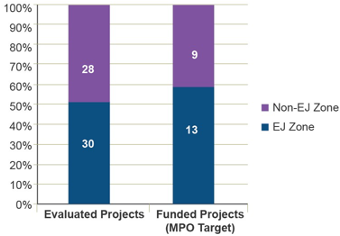
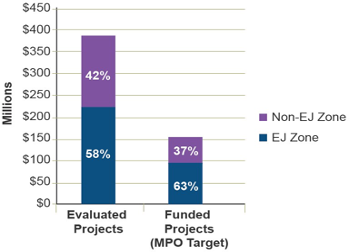
Staff analyzed the Federal Fiscal Years 2012−2017 TIP target program to determine how many evaluated and funded projects are located within one-half mile of an EJ TAZ. Table 5 shows that EJ TAZs fare well during the five-year period covered by this TIP. These TAZs encompass 36% of the MPO’s total population and 71% of the minority population. Meanwhile, more than half of the projects evaluated for funding are in or near EJ TAZs, as are 59% of the projects targeted for funding. The anticipated cost of funded projects is $50 per capita fot theMPO; $88 per capita for EJ TAZs; and $29 per capita for non-EJ TAZs. Evaluated and funded project information also is presented in Figures 3 and 4.
|
MPO Total |
Environ- mental Justice TAZS |
Pct. MPO Total in EJ TAZs |
Non-EJ TAZS |
Pct. MPO Total in Non-EJ TAZs |
Transportation Analysis Zones (TAZs) |
1943 |
675 |
35% |
1268 |
65% |
Population |
3,161,534 |
1,146,334 |
36 |
2,015,200 |
64 |
Minority Population |
878,120 |
622,021 |
71 |
256,099 |
29 |
Number of Evaluated Projects |
58 |
30 |
52 |
28 |
48 |
Number of Funded Projects (MPO Target) |
22 |
13 |
59 |
9 |
41 |
Projects not Funded |
28 |
12 |
43 |
16 |
57 |
Evaluated Projects |
$388,227,468 |
$224,850,374 |
5%8 |
$163,377,094 |
425 |
Funded Projects (MPO Target) |
158,060,585 |
98,896,856 |
63 |
59,163,729 |
37 |
Projects Not Funded |
200,299,854 |
100,923,400 |
50 |
99,376,455 |
50 |
Funded Project Dollars (MPO Target) per Capita |
50 |
86 |
-- |
29 |
- |
Not Funded Project Dollars per Capita |
63 |
88 |
-- |
49 |
|
Evaluated Projects Dollars per Capita |
123 |
196 |
-- |
81 |
|
1 A transportation analysis zone is a unit of geography used in modeling transportation behavior.
2 Title VI Requirements and Guidelines for Federal Transit Administration Recipients, October 1, 2012, p. 1-5