
Click here to view the PDF version of this document
Prepared by
Staff to the Boston Region Metropolitan Planning Organization
Civil Rights Notice to the Public
Welcome. Bem Vinda. Bienvenido. Akeyi. 欢迎. 歡迎
You are invited to participate in our transportation planning process, free from discrimination. The Boston Region Metropolitan Planning Organization (MPO) is committed to nondiscrimination in all activities and complies with Title VI of the Civil Rights Act of 1964, which prohibits discrimination on the basis of race, color, or national origin (including limited English proficiency). Related federal and state nondiscrimination laws prohibit discrimination on the basis of age, sex, disability, and additional protected characteristics.
For additional information or to file a civil rights complaint, visit www.bostonmpo.org/mpo_non_discrimination.
To request this information in a different language or format, please contact:
Boston Region MPO Title VI Specialist
10 Park Plaza, Suite 2150
Boston, MA 02116Phone: 857.702.3700
Email: civilrights@ctps.org
For people with hearing or speaking difficulties, connect through the state MassRelay service, www.mass.gov/massrelay. Please allow at least five business days for your request to be fulfilled.
Contact MPO Staff
By mail:
Sean Rourke
Manager of Communications and Engagement
State Transportation Building
Ten Park Plaza, Suite 2150
Boston, Massachusetts 02116
or
Michaela Grenier
Senior Planner, Public Engagement
State Transportation Building
Ten Park Plaza, Suite 2150
Boston, Massachusetts 02116
By telephone:
857.702.3700 (voice)
For people with hearing or speaking difficulties, connect through the state MassRelay service using the instructions contained in the Civil Rights Notice on the previous page.
By email:
publicinfo@ctps.org
Executive Summary
The Boston Region Metropolitan Planning Organization (MPO) is responsible for conducting the federally required metropolitan transportation planning process for 97 cities and towns in eastern Massachusetts. This Public Engagement Plan establishes the policies and procedures through which the MPO engages the public in its work. The policies and procedures in this Plan apply to the development of the MPO’s certification documents, including the Long-Range Transportation Plan (LRTP), Transportation Improvement Program (TIP), and Unified Planning Work Program (UPWP), in addition to other plans, programs, and projects.
ES.1 Engagement Framework and Goals
The MPO's engagement program is organized around four goals:
- transparency;
- broad and continuous involvement;
- accessibility and reach; and
- adaptability, evaluation, and improvement.
The MPO's engagement framework draws on the Spectrum for Public Participation developed by the International Association for Public Participation.
The MPO's Public Engagement Program provides opportunities for involvement to all interested parties and includes targeted outreach to populations traditionally underserved by the transportation system.
ES.2 Engagement Channels, Standing Programs, and Policies
Public engagement at the MPO occurs through multiple channels. The MPO conducts public engagement throughout the development of its certification documents, holds formal public review periods on draft documents prior to board endorsement, and provides ongoing opportunities for input through twice-monthly MPO board meetings, committee meetings, the Community Advisory Council, the Community Planning Lab, and direct contact with staff. Staff also conduct proactive outreach in community settings, including events, and partnerships with community-based organizations to reach people who may not engage through traditional MPO channels.
The Community Advisory Council is the MPO's permanent advisory body, comprising representatives from community-based organizations, advocacy groups, and other stakeholders. The Advisory Council holds a voting seat on the MPO board and its committees and provides ongoing public and stakeholder input into the MPO’s work.
The Community Planning Lab is a civic education program that builds capacity for participation among representatives from community-based organizations who have had limited prior engagement with transportation planning.
The MPO addresses financial barriers to participation by providing an honorarium, including gift cards, stipends, transit passes, food and beverages at events, and signed arrangements with community-based organizations that contribute substantively to engagement work.
ES.3 Accessible and Inclusive Engagement
The MPO maintains policies to ensure that engagement opportunities are accessible to all members of the public. These policies address physical accessibility of meeting locations, digital accessibility of materials and platforms, virtual meeting accessibility, and language access through translated documents, website translation functionality, and interpretation services.
ES.4 Public Review Periods
Formal public review periods are conducted for certification documents. Minimum review periods range from 21 days for TIP and UPWP amendments to 45 days for the Public Engagement Plan itself. The Public Engagement Plan defines circumstances under which the MPO may modify standard review periods and establishes documentation requirements for any such modifications. MPO staff document and summarize public input received during review periods, present summaries to the MPO board for consideration before endorsement, respond to public comments, and incorporate input summaries into final plan documents.
ES.5 Measurement and Evaluation
The MPO regularly reviews the effectiveness of its engagement strategies. Staff track metrics across reach and geographic and demographic representation and evaluate engagement around three questions: who is participating; is participation changing over time; and is public input reaching decision-makers. Evaluation findings are reported throughout the year via an Engagement Dashboard and through Engagement Updates presented to the MPO board.
The Public Engagement Plan is available on the Boston Region MPO website, along with an Engagement Guidebook containing additional information about how to engage with the MPO’s planning processes. For questions or comments, contact the Public Engagement Program Manager at publicinfo@ctps.org or 857.702.3700.
Chapter 1—Public Engagement at the Boston Region MPO
1.1 Core Functions of the Boston Region MPO
Metropolitan planning organizations (MPO) were established through federal legislation to approve the use of federal funds for transportation planning and capital projects and to carry out a continuing, comprehensive, and cooperative (3C) transportation planning process. Each metropolitan area in the United States with a population of 50,000 or more must have an MPO. The 3C process produces plans and programs that support the development and operation of an integrated, multimodal transportation system.
The Boston Region MPO comprises 97 municipalities in eastern Massachusetts. The MPO makes decisions about long-range planning and the prioritization and allocation of federal transportation funding via a 23-member board made up of state and regional agencies, advisory bodies, and municipalities. Board membership and decision-making structure are documented in the MPO’s Memorandum of Understanding, available at www.bostonmpo.org.
As part of its 3C planning process, the Boston Region MPO produces the following federally required certification documents, among others:
- Long-Range Transportation Plan (LRTP)—updated every five years; establishes the long-term vision and guides capital investment decisions.
- Transportation Improvement Program (TIP)—produced annually; identifies transportation projects receiving federal funding over a five-year period.
- Unified Planning Work Program (UPWP)—produced annually; describes transportation planning work MPO staff will conduct during the federal fiscal year.
- Public Engagement Plan (PEP)—documents the MPO’s public participation procedures and policies; updated as needed.
1.2 The Role of Engagement in the MPO’s Work
Federal law requires MPOs to conduct a continuing, cooperative, and comprehensive public participation process as part of transportation planning. The Boston Region MPO’s public engagement program fulfills this requirement by providing structured opportunities for the public and stakeholders to participate in the development of certification documents and other MPO plans and programs.
Public input is collected through multiple channels, documented, analyzed, and reported to the MPO board. Staff integrate engagement findings into the development of plans and programs. The processes and procedures through which this occurs are described in Chapters 2 through 4 of this Plan.
1.3 Public Participation in the MPO’s Planning Process
Public participation occurs at multiple points in the MPO's planning process. The MPO's engagement program is designed to provide opportunities for participation at the beginning of and throughout the development of plans, programs, and projects, and to enable the public to engage with the MPO on an ongoing basis outside of formal planning cycles.
MPO staff engage the public to identify transportation needs, gather input on priorities, and collect feedback on draft plans and programs. For the LRTP, engagement spans multiple years and includes broad public outreach on regional priorities and investment strategies. For the TIP and UPWP, engagement is conducted annually and is coordinated with the MPO's federal fiscal year planning cycle. Staff tailor engagement strategies and methods to the scope, timeline, and communities relevant to each plan; these strategies and methods are described in Chapter 2.
At key decision points, the MPO conducts formal public review periods. All public input received during review periods is documented, summarized, and presented to the MPO board before endorsement votes. Review period schedules, minimum durations, and related policies are described in Chapter 4.
On an ongoing basis, the public may participate through several standing channels:
- MPO board meetings are held twice per month and are open to the public. Meetings are generally hosted virtually and comply with the Massachusetts Open Meeting Law and applicable state and federal accessibility and language access requirements. Each meeting includes dedicated time for public comment. The Transportation Improvement Program, Unified Planning Work Program, Congestion Management Process, and Administration and Finance committees meet as needed; all are open to the public and follow the same policies.
- The Community Advisory Council is the MPO's permanent advisory body, holding a voting seat on the MPO board and its committees. The Advisory Council provides a structured channel for public and stakeholder input into MPO planning and policy decisions. Its role, membership, and operating procedures are described in Section 2.8.1.
- Members of the public may submit input to MPO staff at any time via the MPO's website or by contacting publicinfo@ctps.org. The MPO publishes meeting notices and a newsletter to inform the public of upcoming meetings, engagement opportunities, and program and project updates.
Beyond these channels, MPO staff conduct proactive outreach in community settings to reach people who may not engage through formal MPO meetings or comment processes. Staff participate in community events and public gatherings, meet with advocacy and community-based organizations, and hold conversations with community leaders, municipal staff, and stakeholders. These activities are designed to collect input from a broader cross-section of the region's population and to build relationships that support sustained engagement.
The Metropolitan Area Planning Council (MAPC) facilitates a subregional municipal engagement program through which coordinators convene regular meetings of municipal staff across the MPO's planning area. MPO staff coordinate with MAPC to share information about MPO programs and engagement opportunities and to gather input on municipal transportation priorities.
The specific methods, strategies, and frameworks the MPO uses to plan and execute engagement are described in Chapter 2.
1.4 Interagency Consultation
Consistent with 23 CFR §450.316(b), the Boston Region MPO consults with agencies and officials responsible for planning activities within the metropolitan planning area that are affected by or related to transportation. This consultation ensures that transportation planning decisions account for and are coordinated with land use, environmental, economic, and infrastructure planning conducted by partner agencies.
The MPO’s primary interagency consultation relationships include the following:
- Massachusetts Department of Transportation (MassDOT): the state transportation agency and permanent chair of the MPO board. Coordination with MassDOT encompasses highway planning, rail, statewide transportation planning and programming, project development, and performance management.
- Massachusetts Bay Transportation Authority (MBTA), Cape Ann Transportation Authority, and MetroWest Regional Transit Authority: the regional transit providers serving the Boston region. The MPO consults with these agencies in the development of the TIP, UPWP, and LRTP, and the transit agencies have concurred that the MPO’s public engagement process for the TIP satisfies their FTA Section 5307 public hearing requirements.
- Massachusetts Port Authority (Massport): responsible for Logan International Airport and the Port of Boston, both of which are significant freight and passenger movement facilities within the planning area. The MPO consults with Massport on freight, aviation, and intermodal considerations in regional transportation planning.
- MAPC: the regional planning agency for the Boston area, responsible for land use, housing, environmental, and economic development planning. The MPO and MAPC coordinate on regional data, planning assumptions, and issues where transportation and land use decisions are interdependent.
- State environmental and natural resource agencies: including the Massachusetts Department of Environmental Protection and the Executive Office of Energy and Environmental Affairs, on matters related to air quality, climate, and environmental compliance relevant to transportation planning.
The formal structure of MPO board membership, interagency relationships, and coordination responsibilities is documented in the MPO’s Memorandum of Understanding, available at www.bostonmpo.org. The MPO’s public participation process is open to all interested parties consistent with 23 CFR §450.316(b), and the MPO may consult with additional agencies on a project or plan-specific basis as relevant.
Chapter 2—Public Engagement Practices
This chapter describes the Boston Region Metropolitan Planning Organization’s (MPO) engagement planning framework, goals and intended outcomes, stakeholders and constituencies, and the strategies and methods the MPO uses to conduct engagement. It also describes the MPO’s ongoing engagement subprograms. Together, these elements fulfill the requirements of 23 CFR §450.316(a)(1) by defining the procedures, strategies, and desired outcomes for public participation in the MPO’s planning process.
2.1 The MPO’s Public Engagement Planning Framework
The Boston Region MPO envisions an equitable, pollution-free, and modern regional transportation system that gets people to their destinations safely, easily, and reliably. The system should also support an inclusive, resilient, healthy, and economically vibrant Boston region.
Public engagement improves decision-making by helping to illuminate the social, economic, and environmental benefits and drawbacks of transportation decisions. The MPO is committed to hearing, valuing, and considering, throughout all planning work, the views of and feedback from the full spectrum of the public and incorporating this input into decision-making.
The MPO’s engagement program is guided by the principles of the International Association for Public Participation (IAP2), which provides a structured framework for defining the public’s role across different phases of a planning process. MPO staff has adapted the IAP2 Spectrum for Public Participation to the context of regional transportation planning, incorporating specific strategies, methods, and metrics applicable to MPO work. The resulting Engagement Strategy Matrix, shown in Figure 1 in Section 2.3, is the MPO’s reference point for aligning engagement approaches to planning contexts and goals. Section 2.3.1 describes the specific engagement methods the MPO uses.
Engagement strategies and methods are tailored to the specific context, goals, and communities relevant to each plan or project. The MPO does not apply a uniform approach across all engagement activities.
2.1.1 Goals and Intended Outcomes
The MPO’s public engagement program is designed to achieve the following goals, consistent with federal public participation requirements:
- Transparency: provide timely, clear, and accessible information about the planning and decision-making process; ensure that MPO plans, products, publications, and decisions are available and understandable to all audiences.
- Broad and continuous involvement: provide structured opportunities for public involvement at the beginning of and throughout the development of plans, programs, and projects; communicate how public input has been considered in planning decisions.
- Accessibility and reach: conduct engagement in a manner that is physically, linguistically, and culturally accessible to all members of the public; implement targeted outreach strategies to reach persons with disabilities, persons with limited English proficiency, and populations that have historically had limited access to the transportation planning process, consistent with Title VI of the Civil Rights Act of 1964 and 23 CFR §450.316.
- Adaptability, evaluation, and improvement: evaluate engagement processes and outcomes on a regular basis; identify and address gaps; update strategies in response to changing local contexts, needs, and priorities.
Intended outcomes of public engagement at the Boston Region MPO include
- stakeholders who are informed about and able to participate in the regional transportation planning process;
- engagement processes that are consistently implemented across the development of plans, projects, and programs; and
- planning and investment decisions that demonstrably incorporate and respond to public and stakeholder input.
2.2 Stakeholders and Constituencies
Consistent with 23 CFR §450.316, the MPO’s public participation program provides reasonable opportunities for involvement to all interested parties. The MPO identifies the following as key stakeholders and constituencies:
- Members of the public who live, work, learn, and travel in the Boston region
- Community-based organizations and groups
- Advocates focused on transportation and issues related to transportation, including the environment, housing, social services, and economic development
- Affordable housing organizations
- Municipal staff and local elected officials
- Transit agencies and transit providers
- State and regional agencies
- Professional and business organizations and entities
- Schools and academic and research institutions
Federal regulations, including 23 CFR §450.316(a)(1)(vii) and Title VI of the Civil Rights Act of 1964, require the MPO to seek out and consider the needs of populations that are traditionally underserved by existing transportation systems and that may face challenges accessing employment and other services. The MPO’s engagement program, therefore, includes targeted outreach strategies to reach these populations, which include
- persons with disabilities,
- persons with limited English proficiency,
- low-income households,
- minority populations, and
- populations with limited prior engagement in the regional transportation planning process.
2.3 Strategies and Methods
The MPO’s Engagement Strategies Matrix aligns engagement strategies and methods to levels of public participation, consistent with the IAP2 framework. Staff use this matrix to inform appropriate engagement approaches for specific plans, programs, and projects.
Figure 1
Engagement Strategies Matrix
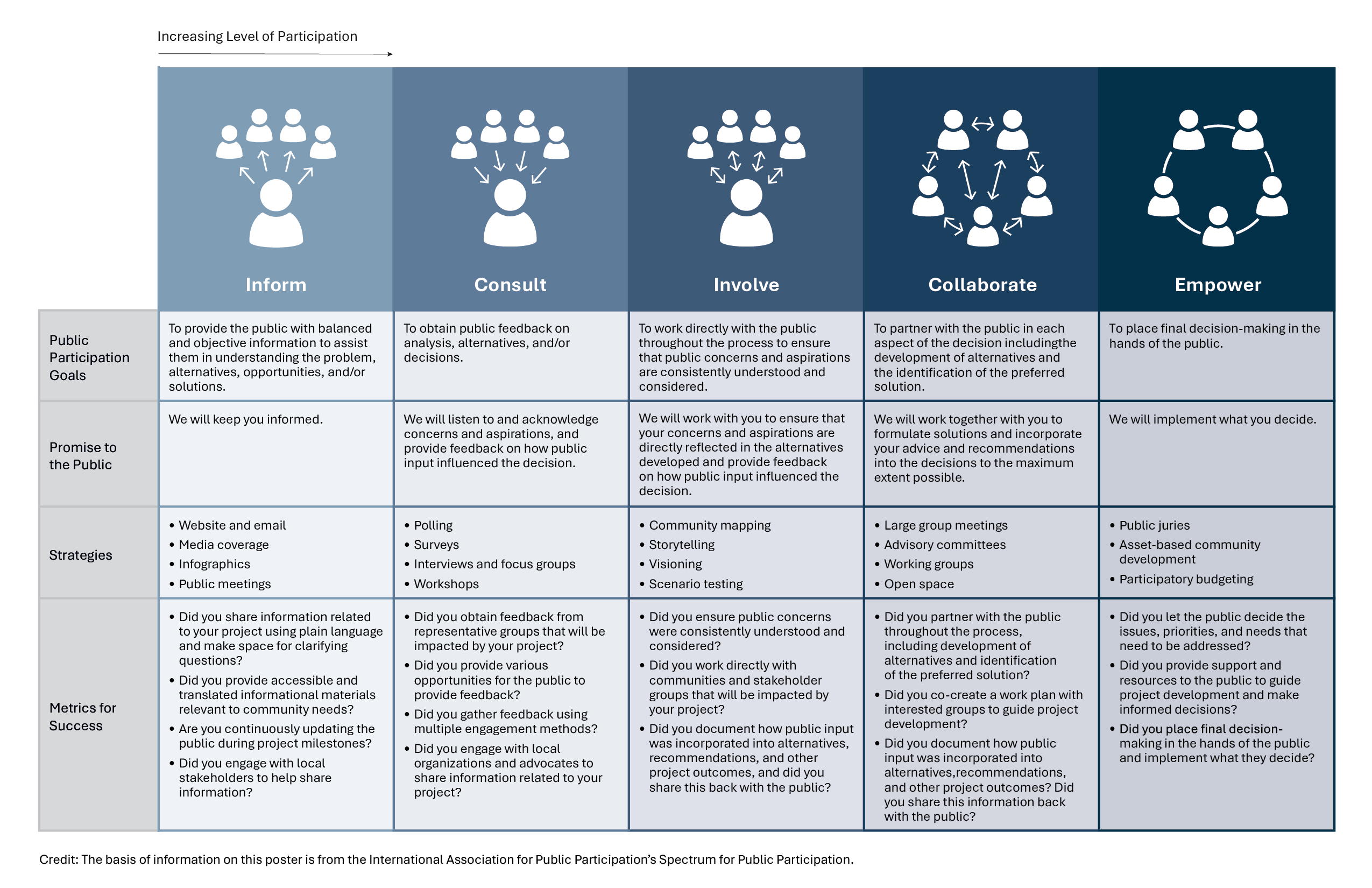
Sources: International Association for Public Participation (IAP2), Boston Region MPO staff.
2.3.1 Engagement Methods
MPO staff select and combine engagement methods based on the goals, context, and intended audiences of each plan or project. The following methods are used across the MPO’s engagement activities.
Communication and Outreach
Boston Region MPO website
The MPO’s primary public information channel. Meeting notices, agendas, materials, plans, and engagement opportunities are posted on the website and updated regularly.
Digital newsletter
A recurring email newsletter distributed to subscribers, covering upcoming meetings and events, program and project updates, and public comment opportunities.
Email lists
Direct email notifications are sent to stakeholder lists for specific plans, projects, and public review periods. Members of the public can subscribe to receive updates.
Social media: The MPO maintains accounts on multiple social media platforms to distribute timely information, promote engagement opportunities, and reach audiences who may not regularly visit the Boston Region MPO website.
Press releases and media outreach: Staff issue press releases and coordinate with local and regional media outlets to publicize plans, public review periods, and engagement opportunities.
Public Involvement Activities
Public meetings
Formal meetings at which staff present information and members of the public may provide oral and written comments. These are held for major plans and amendments, with notice provided per applicable public review period and Massachusetts Open Meeting Law requirements.
Workshops
Structured sessions focused on specific topics or plans, designed to facilitate discussion and collect input on particular planning questions or decisions.
Community tabling and outreach events
Staff participate in community events, farmers' markets, festivals, and other public gatherings to provide information and collect input from people who may not attend formal MPO meetings.
Surveys and polls
Online and in-person surveys are used to collect structured input from members of the public on transportation needs, priorities, and plan elements. Surveys are designed to reach a broad audience and are distributed through multiple channels.
Interactive online tools
Staff use digital platforms, including real-time polling tools, online mapping, and idea-submission platforms, to collect input during presentations and plan engagement.
Direct contact and correspondence
Members of the public may contact MPO staff directly by phone, email, or the website. Staff respond to all inquiries and track input received through direct contact.
One-on-one and small group conversations
Staff engage directly with community leaders, organizational representatives, and stakeholders through individual conversations and small group meetings to build relationships and gather input outside of formal meeting settings.
Collaborative Engagement
Community Advisory Council
The MPO’s permanent advisory body, described in Section 2.8.1, provides ongoing advisory input into MPO plans and programs.
Project advisory groups
For specific plans and studies, the MPO may convene project-specific advisory groups comprising stakeholders with particular expertise or interest in the project’s subject matter.
Partnerships with community-based organizations
Staff develop ongoing relationships with community organizations to reach people who may face barriers to participation in formal MPO processes. These partnerships support targeted outreach and help ensure input reflects a broad range of perspectives.
MPO committees
The Transportation Improvement Program, Unified Planning Work Program, Congestion Management Process, and Administration and Finance committees provide dedicated forums for stakeholder and agency input at key decision points.
2.3.2 Engagement Formats
The Boston Region MPO conducts public meetings and engagement activities using a combination of virtual and in-person formats.
The majority of MPO board and committee meetings are held virtually, with some held in a hybrid virtual and in-person format. This practice is consistent with the Massachusetts Open Meeting Law and subject to modification as state law evolves. Virtual and hybrid meetings typically use the Zoom platform. Meeting links, agendas, and supporting materials are posted on the MPO’s website in advance, and recordings are posted following each meeting.
Engagement outside of board and committee meetings, including community events, tabling, workshops, and Community Advisory Council meetings. These activities are conducted in person, virtually, or in a hybrid format, depending on the context, goals, and communities the activity is intended to reach.
2.4 Visualization Techniques
Consistent with 23 CFR §450.316(a)(1)(iii), the MPO employs visualization techniques to describe transportation plans and programs in formats that are accessible and understandable to a broad public audience. Visualization supports public participation by making complex technical information legible to people who are not transportation planning professionals.
The MPO uses the following visualization approaches:
- Maps and geographic information system (GIS) outputs: Staff produce maps illustrating the geographic distribution of transportation projects, planned investments, and engagement activity. Maps are used in public presentations, plan documents, and online platforms. ArcGIS tools including ArcGIS Online, StoryMaps, Dashboard, and Experience Builder are used to create both static and interactive map products.
- Charts, graphs, and data displays: Staff produce visual summaries of transportation data, performance measures, and engagement findings for use in board presentations, plan documents, and public-facing materials. The MPO’s Engagement Dashboard presents public input data in an interactive format accessible to board members and the public.
- Diagrams and infographics: Staff develop simplified visual representations of planning processes, timelines, and decision frameworks to support public understanding of MPO work.
- Online and interactive tools: MPO staff develop and use online platforms that allow the public to explore transportation data, review draft plans, and provide input in accessible digital formats. For in-person engagement events, staff have several interactive tools available, including a game that lets participants design a street using various Complete Streets elements, and a board game that teaches about the regional capital funding process.
Visualization products are made available on the MPO’s website. Staff apply accessibility standards to all visual materials, including alternative text for digital images and accessible color palettes, and other practices consistent with federal accessibility requirements.
2.5 Accessibility
The MPO is committed to ensuring that its programs, meetings, and materials are accessible to all members of the public, consistent with the Americans with Disabilities Act, Section 504 of the Rehabilitation Act, and Title VI of the Civil Rights Act of 1964.
2.5.1 Electronically accessible formats
Plans, reports, and engagement materials are posted on the MPO's website in formats compatible with screen readers and other assistive technologies. Staff apply accessibility standards to all digital materials, including navigable table structures and alternative text for images and figures.
2.5.2 Physical accessibility
All in-person MPO meetings are held in locations that are accessible to persons with disabilities and are located near public transportation. When selecting venues for meetings and events held outside the MPO's offices, staff review meeting facilities to confirm they meet accessibility standards, including entrances, restrooms, and seating.
2.5.3 Virtual accessibility
Automated captioning is enabled for virtual meetings. Communication Access Real-time Translation service is available upon request. American Sign Language interpretation is available upon request. Meeting participants are asked to submit accessibility accommodation requests to MPO staff at least five business days in advance of a meeting. Contact information for accommodation requests is provided in meeting notices and on the MPO's website.
2.6 Language Access
The MPO provides language assistance services to persons with limited English proficiency, consistent with Title VI of the Civil Rights Act of 1964 and the MPO's Language Assistance Plan. The MPO's website includes a translation function for the six most commonly spoken non-English languages in the region as identified in the Language Assistance Plan. Vital documents, as designated in the Language Assistance Plan, are professionally translated into the six most commonly spoken non-English languages in the region and posted in accessible formats. Language interpretation is available upon request for MPO meetings and events. When selecting meeting locations, staff consult the Language Assistance Plan to determine whether translated materials or interpretation services may be needed based on the language demographics of the surrounding community.
2.7 Participant and Partner Financial Recognition
Meaningful public engagement depends on the willingness of community members and organizations to contribute their time, expertise, and lived experience to the planning process. The MPO recognizes that financial barriers can limit participation, particularly among individuals and community-based organizations representing populations that have been historically underrepresented in transportation planning. To acknowledge these contributions and address barriers to participation, the MPO may provide financial recognition to individuals and organizations whose participation directly supports the transportation planning process.
Financial recognition may take several forms depending on the nature and scope of participation. Individual participants may receive small-value gift cards for participation in intercept surveys or similar outreach activities. Community-based organizations that assume an active role in engagement or advisory processes may enter into signed arrangements with the MPO for ongoing programs, discrete planning projects, or time-bound outreach initiatives. Other forms of financial recognition include providing food and beverages at events and providing transit passes to cover the costs of traveling to and from events.
Such incentives are provided when it is determined that engagement would be less representative or less effective without such support. The MPO does not provide a stipend or honoraria to government agencies, transit service providers, or private business entities. All financial recognition is classified as participant support costs consistent with 2 CFR § 200.456 and is included in the MPO's Unified Planning Work Program budget, which is approved by the Federal Highway Administration and the Federal Transit Administration.
2.8 Program Activities
The Public Engagement Program conducts engagement throughout the development cycles of MPO plans and implements federally required public participation processes. In addition, the Program advances its goals through the following ongoing subprograms and activities.
2.8.1 Community Advisory Council
The Community Advisory Council (Advisory Council) is the MPO’s permanent, independent advisory body. The Advisory Council holds a voting seat on the MPO board and its committees and participates in the development of MPO programs and projects. Its role is to advise the MPO board and staff on regional transportation issues and to provide a channel through which public and stakeholder perspectives inform planning and policy decisions, including the development and implementation of the Public Engagement Plan.
Administration and facilitation of the Advisory Council are managed and funded through the MPO’s Public Engagement Program. MPO staff support Advisory Council members’ engagement with MPO work, create engagement opportunities at key decision-making points, and evaluate the impact of the Advisory Council’s input in the planning process. MPO staff, in collaboration with the Advisory Council Chair and Vice Chair, conduct periodic reviews of the Advisory Council’s function and efficacy.
Membership
The Advisory Council maintains between 10 and 30 active members. Members include representatives of advocacy organizations, community-based organizations, professional organizations, and municipalities, as well as unaffiliated community advocates and members of the general public. Members are selected through an application process administered by MPO staff. Members representing advocacy and community-based organizations receive a stipend for their participation; unaffiliated members receive per-meeting financial recognition. The Advisory Council Charter, available on the MPO’s website, describes membership eligibility, the application process, and roles and responsibilities in full.
Meetings
The Advisory Council meets approximately 11 times per year, holding monthly meetings with a recess typically in the summer. Meetings are held virtually on Zoom on a regular, recurring schedule. Meetings are public and comply with the Massachusetts Open Meeting Law (OML), with the exception of internal training or educational sessions. MPO staff circulate agendas and materials one week prior to meetings and post all materials at least 48 hours in advance per OML requirements. Staff prepare meeting summaries following each meeting.
2.8.2 Community Planning Lab
The Community Planning Lab is a civic education program through which a cohort of representatives from community-based organizations participates in a learning program focused on the MPO’s work and the regional transportation planning process. The program builds capacity for participation among people who have had limited prior engagement with transportation planning.
Cohorts are programmed annually as full-day educational sessions organized around a topic or theme. Content typically covers core MPO planning processes, such as the Long-Range Transportation Plan and Transportation Improvement Program, alongside topical planning areas such as active transportation and infrastructure resilience. The program emphasizes peer learning and hands-on approaches, including role-playing activities, group discussion, and interactive exercises designed to make the technical aspects of transportation planning accessible to participants without prior experience in the field.
Cohorts are made up of participants from organizations serving populations historically underrepresented in transportation planning. Organizations providing participants receive stipends in recognition of their time and expertise, consistent with the MPO's policy on participant and partner financial recognition.
Chapter 3—Measurement and Evaluation
Federal regulations require the Boston Region Metropolitan Planning Organization (MPO) to periodically review the effectiveness of the procedures and strategies contained in this Plan to ensure a full and open participation process. This chapter describes how the MPO collects, manages, analyzes, and reports on engagement data to fulfill this requirement and to improve engagement practices over time.
3.1 Data Collection, Management, and Analysis
MPO staff maintain a centralized data collection and management system for tracking public input. Staff record input received through all engagement channels—including community events, one-on-one conversations, and board and committee meetings—and code it by topic, theme, stakeholder type, and location. Staff analyze these data to assess the reach and effectiveness of engagement efforts and to identify gaps.
MPO staff have developed practices to ensure consistent implementation of engagement procedures across the agency. These include procedures for coordinating with the Communications and Engagement team, conducting engagement evaluations, and obtaining translations and interpretation services for public materials and meetings.
MPO staff capture quantitative and qualitative metrics to evaluate engagement effectiveness. Staff review these metrics regularly to inform ongoing adjustments to engagement strategies.
The MPO tracks the following metrics to evaluate engagement effectiveness.
3.1.1 Reach and Participation
- Number of public comments received, by channel (e.g., email, online platform, in-person event, board meeting)
- Number of engagement activities conducted by type (e.g., community tabling, workshop, public meeting, survey)
- Meeting and event attendance, including virtual attendance where applicable
- Survey response counts
- Email audience metrics and open rates
- Social media engagement metrics (impressions, interactions)
3.1.2 Geographic and Demographic Representation
- Geographic distribution of public input, mapped by municipality and sub-region
- Proportion of engagement activity conducted in communities identified through the MPO’s Title VI analysis
- Demographic data on participation, where collected (e.g., through voluntary survey questions)
- Number of events conducted in partnership with community-based organizations serving historically underrepresented populations
3.1.3 Evaluation Framework
MPO staff evaluate engagement effectiveness through a combination of quantitative analysis and qualitative assessment. The evaluation framework is structured around three questions:
Who is participating?
Staff compare the geographic and demographic distribution of engagement activity against the distribution of the region’s population, with particular attention to whether communities identified through the MPO’s Title VI analysis are proportionally represented. Persistent underrepresentation in specific communities or population groups is flagged for targeted outreach in the following fiscal year.
Is participation changing over time?
Staff track trends in key metrics, including comment volume and geographic coverage, to identify whether engagement is growing, stable, or declining. Significant shifts in any metric are analyzed to determine whether they reflect changes in outreach strategy, public interest, or external factors.
Is public input reaching decision-makers?
Staff assess whether engagement findings are being transmitted to the MPO board in a timely and usable format, and whether board discussions and planning documents reflect the input received.
Evaluation findings inform adjustments to outreach strategies, event formats, and resource allocation for the following fiscal year. When evaluation identifies a significant gap, such as a geographic area or population group consistently underrepresented in engagement data, staff adjust strategies, which may include new community partnerships, revised event locations, or additional translated materials. The MPO recognizes that the effectiveness of engagement is highly context-specific. Therefore, evaluation prioritizes equitable representation across diverse demographics, trend direction, and the demonstrated connections between input and decisions.
3.2 Reporting
MPO staff report on engagement activities and findings to the MPO board regularly. These reports draw on collected input to inform the board of public and stakeholder priorities and to document how engagement informs planning decisions.
3.2.1 Engagement Updates and Dashboard
MPO staff present Engagement Updates to the MPO board on a regular basis. These updates synthesize engagement activity and public input findings to inform the board of stakeholder priorities and participation trends across MPO programs and projects.
Supporting these updates, the MPO maintains a publicly accessible Engagement Dashboard, updated quarterly. The dashboard is the MPO’s primary tool for presenting engagement data in an accessible, interactive format, and tracks
- individual public comments received by the MPO;
- the geographic distribution of public input;
- comment themes and trends over time;
- demographic data on participation; and
- engagement event activity.
The dashboard is available to the public on the MPO’s website and serves as a reference for board members seeking current engagement data between formal board presentations. Staff use the dashboard to identify gaps in participation and inform engagement strategies.
3.3 How Engagement Impacts Planning Decision-Making
The MPO’s engagement efforts are designed not only to collect public input but to ensure that input demonstrably informs planning and investment decisions. Staff accomplish this through three mechanisms:
3.3.1 Documentation and transmission
All public input is recorded, coded, and transmitted to the MPO board through the reporting channels described in Section 3.2. During public review periods, staff compile comment summaries that present each comment alongside a staff response describing how the input was or will be addressed. These summaries are included as appendices to the final plan documents and are available on the MPO’s website.
3.3.2 Integration into plan development
Staff incorporate engagement findings into the development of certification documents at key decision points. For the Long-Range Transportation Plan, this includes reflecting public input on regional priorities, investment strategies, and project evaluation criteria. For the Transportation Improvement Program, engagement findings inform the project scoring process and funding allocation. For the Unified Planning Work Program, community input may shape programmatic work planning and the selection or scope of planning studies.
3.3.3 Communication to the public
The MPO communicates how public input has been considered in planning decisions through multiple channels: public input summaries in document appendices, follow-up conversations with the Advisory Council and other stakeholder groups, and direct responses to individual commenters. This feedback loop is essential to maintaining public trust in the engagement process and to meeting the federal requirement that the MPO demonstrate explicit consideration and response to public input (23 CFR §450.316(a)(1)(vi)).
When public input cannot be considered in the course of decision-making (for example, because a comment addresses a topic outside the MPO’s jurisdiction or conflicts with a federal requirement), staff explain the reason in their response.
Chapter 4—Public Review Periods and Policies
Public engagement occurs continuously at the Boston Region Metropolitan Planning Organization (MPO), with staff engaging stakeholders and members of the public throughout the MPO’s planning and projects. Before being endorsed by the MPO board, certification documents and their amendments must be made available for public review.
The MPO’s public review policies are derived from Title 23, Section 450 of the Code of Federal Regulations (§450.316), which governs public involvement requirements for the development of certification documents and their amendments. Consistent with §450.316, the MPO’s policies require that certification documents provide “adequate time for public review and comment at key decision points, including a reasonable opportunity to comment on the proposed [plans].” The MPO’s policies meet these regulations by requiring multiweek public review periods for all certification documents prior to their endorsement. For amendments to certification documents (changes deemed substantial, in comparison to smaller administrative modifications), the MPO also requires multiweek public review periods, except for the Unified Planning Work Program (UPWP).
4.1 Public Review Period Schedule
Table 1 describes the public review schedule and minimum requirements for public review periods for certification documents.
Table 1
Public Review Schedule for Certification Documents
| Document | Full document review period | Amendment review period | Policy for reducing or waiving |
| TIP | 21 days minimum | 21 days minimum | Extreme circumstances: 15 days minimum. Emergency circumstances: waive. |
| UPWP | 21 days minimum | Not required | At committee recommendation and board discretion; if instituted, 15 days minimum |
| LRTP | 30 days minimum | 30 days minimum | Extreme circumstances: 15 days minimum. Emergency circumstances: waive. |
| PEP | 45 days minimum | 45 days minimum | Not allowed per federal regulation. |
| CPT–HSTP | 21 days minimum | Not required | Extreme circumstances: 15 days minimum. Emergency circumstances: waive. |
| Title VI Report | 21 days minimum | Not required | Extreme circumstances: 15 days minimum. Emergency circumstances: waive. |
| Language Assistance Plan | 21 days minimum | Not required | Extreme circumstances: 15 days minimum. Emergency circumstances: waive. |
CPT—HSTP = Coordinated Public Transit—Human Services Transportation Plan. LRTP = Long-Range Transportation Plan. PEP = Public Engagement Plan. TIP = Transportation Improvement Program. UPWP = Unified Planning Work Program.
4.2 Public Review Period Policies
Any change to the Long-Range Transportation Plan (LRTP) is generally considered an amendment. For the Transportation Improvement Program (TIP), amendments are required (1) if there is a change in project cost of $500,000 or more for a project valued at five million dollars or less, or a change of 10 percent or more of the project cost for projects valued at greater than five million dollars; (2) if there is a proposal to add or remove a project; or (3) if the programming year of a project is changed. Changes to the UPWP, such as the addition or deletion of an MPO-funded study or project, major changes to a task description, and funding changes of 25 percent or more, also necessitate an amendment.
Changes to certification documents that do not constitute an amendment may be addressed through an administrative modification or adjustment. Administrative modifications and adjustments do not require a public review period.
In extreme circumstances, such as an unforeseen regulatory requirement, the MPO may vote to shorten a public review period for an amendment to a minimum of 15 days. In emergency circumstances, such as when immediate action is needed to protect public safety or to take advantage of an extraordinary funding opportunity, the MPO may waive the public review period.
If a significant alteration occurs to a full document after the close of the initial public review period, the MPO will schedule an additional public review period according to the timelines in Table 1. If a significant alteration occurs to an amendment after the close of the initial public review period, an additional 15-day or 21-day public review period will be scheduled for TIP and UPWP amendments, a 30-day period for LRTP amendments, and a 45-day review period for PEP amendments.
A public review period begins once the document or amendment is posted on the MPO’s website or once a notification email is sent, whichever occurs first. To allow time to develop notification materials, the earliest a public review period can begin is the first full business day following the board’s decision to conduct one. To allow time to report and post public input, the shortest allowable public review period is 15 days, and no public review period shall conclude fewer than four full business days before the MPO meeting where endorsement is expected to occur.
During public review periods, staff create and publicize opportunities for members of the public to provide feedback via
- MPO communications channels (email, Boston Region MPO website, and social media);
- engagement with the Community Advisory Council, regional agency partners, municipalities, community-based organizations, and other local stakeholders; and
- hosting office hours or information sessions.
MPO staff summarize input received during public review periods for the MPO board to consider before voting to endorse each plan. Summaries include information about the commenter (typically name and affiliation), the nature or focus of the comment, and MPO staff’s response. Staff strive to respond to all public input received during review periods within five business days. Summaries of input are then incorporated into the appendices of the final plan documents. For amendments, input is shared with the MPO board in summary form.
4.3 Definitions
These terms are defined by the MPO to implement the review period policies described in Table 1. The policies reflect the MPO's interpretation of the public participation requirements in 23 CFR §450.316, which establishes minimum review periods and requires that the public have adequate time for review and comment at key decision points. The definitions below establish criteria and documentation requirements for circumstances in which the MPO may modify its standard review periods.
4.3.1 Extreme Circumstances
An extreme circumstance is a situation in which an unforeseen external requirement creates a timeline constraint that makes the standard review period impracticable. Examples include an unanticipated federal or state regulatory deadline, a mandated funding obligation deadline that cannot be met under the standard review timeline, or a time-sensitive interagency coordination requirement. The MPO board must vote to invoke this provision, and the shortened review period must be at least 15 days. The board’s rationale for invoking extreme circumstances is documented in the meeting minutes and in the affected plan’s public review summary.
4.3.2 Emergency Circumstances
An emergency circumstance is a situation requiring immediate MPO action to protect public safety, to comply with an imminent legal or regulatory mandate, or to secure an extraordinary and time-limited funding opportunity. The MPO board must vote to invoke this provision and waive the review period and must document its rationale in the meeting minutes. Emergency circumstances are expected to be rare and are not invoked for schedule convenience or workload management.
4.3.3 Significant Alteration
A significant alternation is a substantive change to a certification document after the close of its public review period that materially affects the document’s content, scope, or policy direction. Routine editorial corrections, formatting changes, and minor technical revisions do not constitute a significant alteration. The MPO board, after consulting federal guidelines, determines whether a post-review change constitutes a significant alteration; if so, an additional review period is scheduled per the timelines in Table 1.
Appendix A—Federal Compliance Requirements
This Public Engagement Plan is prepared in accordance with 23 CFR §450.316, which requires each metropolitan planning organization (MPO) to develop and use a documented participation plan. The Plan defines explicit procedures, strategies, and desired outcomes for public participation in the metropolitan transportation planning process. Per federal regulation, the Plan is subject to a minimum 45-day public review period before adoption by the MPO board, and copies of the adopted Plan are provided to the Federal Highway Administration and Federal Transit Administration for informational purposes and posted on the Boston Region MPO’s website.
Federal Statutes and Regulations
The table below identifies the federal statutes and regulations that govern the Boston Region MPO’s public participation program, with links to current authoritative sources.
| Statute or Regulation | Description |
| 23 CFR §450.316 Interested Parties, Participation, and Consultation | Core metropolitan planning participation requirement. Establishes requirements for documented participation plans, interagency consultation and coordination, stakeholder engagement, public notice, visualization, accessibility, and periodic review. |
| 23 CFR §450.318 Public Participation for Planning Studies and Project Development | Specifies public participation requirements for MPO planning studies and project development. |
| 23 CFR 450.324 Development and Content of the Long-Range Transportation Plan | Specifies public participation requirements for the development and content of the LRTP. |
| 23 CFR 450.326 Development and Content of the Transportation Improvement Program | Specifies public participation requirements for the development and content of the TIP. |
| Infrastructure Investment and Jobs Act (IIJA), Section 5303 (49 U.S.C. §5303) | Establishes updated metropolitan transportation planning requirements, including public participation provisions and expanded stakeholder types (including affordable housing organizations). |
| Title VI of the Civil Rights Act of 1964 (42 U.S.C. §2000d et seq.) and 49 CFR Part 21 | Prohibits discrimination on the basis of race, color, or national origin in federally assisted programs. Implementing regulations (49 CFR Part 21) include requirements for meaningful access for persons with limited English proficiency. |
| Americans with Disabilities Act (ADA) of 1990 (42 U.S.C. §12101 et seq.) and 49 CFR Parts 27, 37, 38 | Prohibits discrimination on the basis of disability in programs and activities of public entities and recipients of federal financial assistance. Implementing regulations (49 CFR Parts 27, 37, and 38) establish accessibility requirements applicable to recipients of USDOT funding. |
| Section 504 of the Rehabilitation Act of 1973 (29 U.S.C. §794) and 49 CFR Part 27 | Prohibits discrimination against individuals with disabilities in programs receiving federal financial assistance. |
MPO = metropolitan planning organization. TIP = Transportation Improvement Program. UPWP = Unified Planning Work Program. USDOT = United States Department of Transportation.
Federal Requirements Checklist
Per 23 CFR §450.316(a)(1), the MPO’s participation plan must describe explicit procedures, strategies, and desired outcomes for each of the following requirements:
- Providing adequate public notice of participation activities and time for review and comment at key decision points
- Providing timely notice and reasonable access to information about transportation issues and processes
- Employing visualization techniques to describe transportation plans and Transportation Improvement Programs
- Making public information available in electronically accessible formats
- Holding public meetings at convenient and accessible locations and times
- Demonstrating explicit consideration and response to public input received during plan development
- Seeking out and considering the needs of those traditionally underserved by existing transportation systems
- Providing an additional opportunity for public comment if a final plan differs significantly from the version made available for comment
- Coordinating with statewide transportation planning public involvement processes
- Periodically reviewing the effectiveness of participation procedures and strategies
Statewide Coordination
The Boston Region MPO coordinates its public participation activities with MassDOT’s statewide transportation planning public involvement and consultation processes, consistent with 23 CFR §450.316(a)(1)(ix). This coordination includes consultation on shared engagement activities, plan development timelines, and public review periods where applicable.
Tribal Consultation
Massachusetts has two federally recognized tribes: the Mashpee Wampanoag Tribe, with reservation lands in Barnstable and Bristol Counties, and the Wampanoag Tribe of Gay Head (Aquinnah), located on Martha’s Vineyard. Neither tribe’s reservation land falls within the Boston Region MPO’s 97-municipality planning area. The MPO recognizes that members of federally recognized tribes may live, work, or travel within the planning area, and the MPO’s general public engagement processes are available to all interested parties. However, because no reservation land falls within the planning area, this Plan does not include a formal tribal consultation process.
Appendix B—Civil Rights and Accommodations
The Boston Region Metropolitan Planning Organization (MPO) is committed to nondiscrimination in all programs, services, and activities in compliance with applicable federal and state civil rights laws. The documents listed below describe the MPO’s civil rights policies and procedures, accommodation resources, and language assistance programs. All documents, including translations, are available at www.bostonmpo.org/mpo-non-discrimination.
| Document | Description |
| Civil Rights Notice to the Public | The MPO’s nondiscrimination notice, describing protected classes and how to access programs and services free from discrimination. |
| Title VI Complaint Procedures | Procedures for filing a civil rights complaint with the Boston Region MPO, including timelines and contact information. |
| 2023 Title VI Report | The MPO’s most recent Title VI compliance report, documenting the MPO’s nondiscrimination programs and activities. |
| Language Assistance Plan | Describes the MPO’s procedures for providing language access services to persons with limited English proficiency, including translation and interpretation. |
MPO = metropolitan planning organization.
Accommodations at MPO Meetings and Events
Upon request, the MPO will make every effort to provide accommodations at MPO-sponsored meetings and events, including meeting materials in accessible formats, materials in languages other than English, and interpretation in American Sign Language and other languages.
Meeting participants are asked to submit accessibility accommodation requests to MPO staff at least five business days in advance of a meeting. To request accommodations, contact
Boston Region MPO Title VI Specialist
10 Park Plaza, Suite 2150, Boston, MA 02116
Phone: 857.702.3700
Email: civilrights@ctps.org
For people with hearing or speaking difficulties, the state MassRelay service may be accessed at www.mass.gov/massrelay.