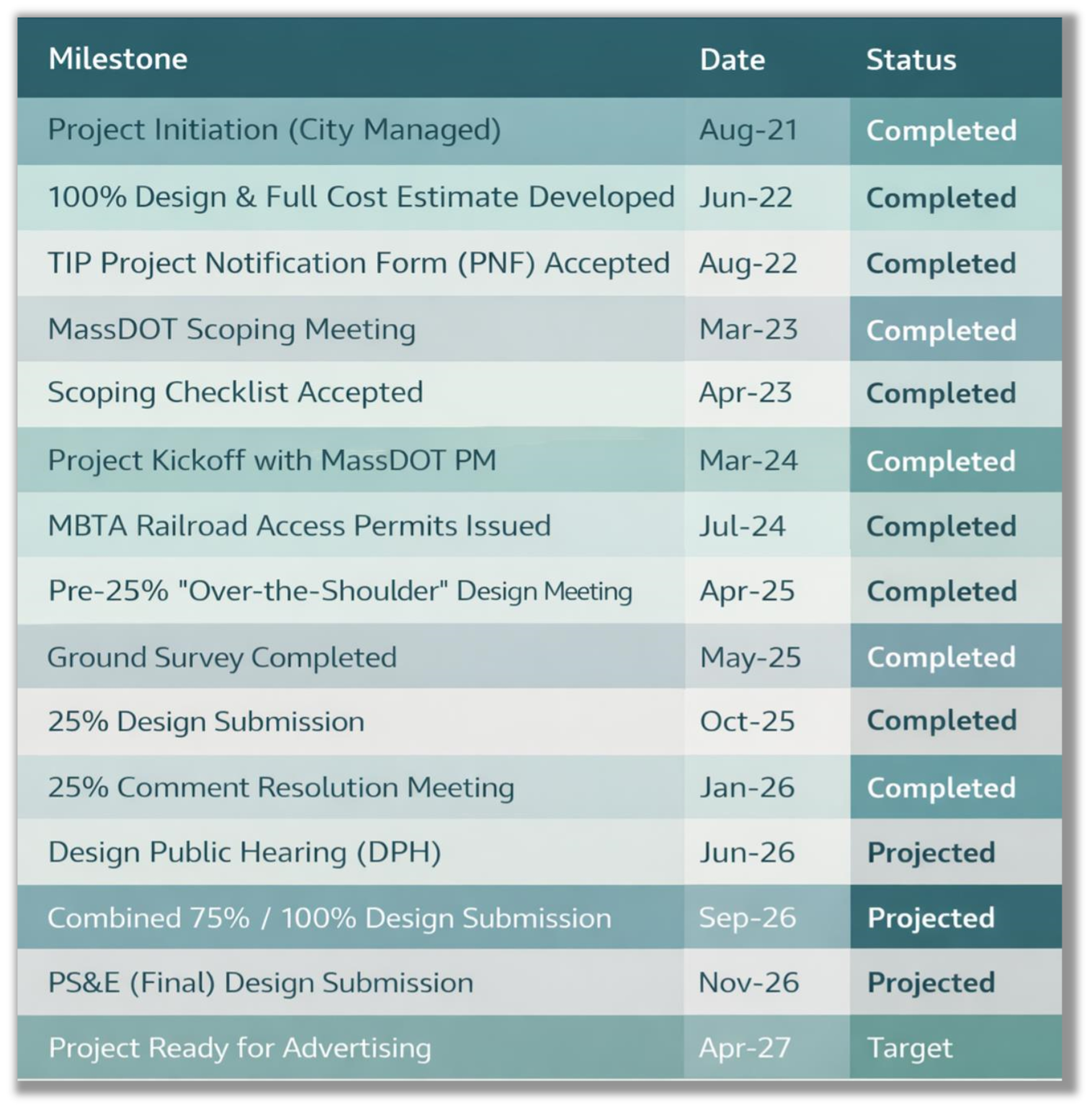
✦ Overview: The Cambridge Street Bridge preservation project meets the criteria discussed at the Metropolitan Planning Organization’s TIP Process, Engagement, and Readiness Committee as an appropriate exception to the TIP Readiness Guidelines. It is a simple project scope with minimal right-of-way impacts, an advanced design status, and a clear regional benefit to an earlier advertisement. As of this March 2026 meeting, the project has already cleared the critical twenty-five percent design submission milestone and completed the subsequent comment resolution process. The existing city layout is adequate for the proposed scope, requiring no permanent land takings or alterations. Right-of-way involvement is limited to four temporary construction access easements on private property to facilitate driveway and sidewalk tie-ins, with all rail access managed through standard licensing agreements with the MBTA and CSX.
✦ Need: The urgency for this bridge to go to construction by Federal Fiscal Year 2028 is driven by both structural necessity and regional coordination. Recent inspections have identified significant deficiencies in the bridge deck, expansion joints, and structural steel that will accelerate if left unaddressed, eventually leading to a more costly and disruptive full superstructure replacement. Delaying the project beyond 2028 risks a structural re-rating by MassDOT that could impose weight restrictions, severely impacting transit and commercial logistics throughout Charlestown and East Somerville which would necessitate costly repairs by the City that this project means to avoid. Furthermore, this project should precede the major Rutherford Avenue and Sullivan Square projects to ensure that this critical link is completed before regional traffic patterns shift.
✦ Suitability: The Cambridge Street Bridge is an ideal candidate for preservation at this time as its structural deficiencies can be fully addressed by replacing the aging concrete deck and repairing and refurbishing the existing steel without altering the critical clearances for the rail lines below or the interstate above. By reducing the roadway width from fifty-five feet to forty-two feet, the project significantly expands the sidewalks into fifteen-foot shared-use paths, providing a much safer environment for pedestrians and cyclists. This targeted rehabilitation restores the bridge’s integrity and improves its layout, offering a durable and cost-effective solution that avoids the massive disruption of a full superstructure replacement.
✦ Budget: The current project valuation is $20,700,000, an increase from the initial $16,000,000 request. This cost escalation is primarily attributed to an expansion of the project limits from the original bridge rehabilitation project to include an additional four hundred feet of roadway/sidewalk reconstruction and civil work west of the bridge, ensuring a seamless tie-in to the City’s "Lost Village" project at Brighton Street. Other contributors include the widened sidewalks, structural replacement of beamlines to support the grade-separated cycling and a general adjustment of unit prices to reflect post-pandemic market values. This investment delivers a cost-effective preservation solution that restores structural integrity while supporting the long-term transportation goals of the community.
✦ Advertising: The project is moving toward advertising significantly faster than a typical roadway reconstruction project due to proactive stakeholder engagement. The roadway cross-section and project limits were finalized through intensive coordination with MassDOT, the City of Boston, and the MBTA well before the twenty-five percent submission, eliminating the typical mid-design delays associated with scope changes. Because the project is categorized as bridge preservation, the design schedule has been further compressed by combining the seventy-five and one-hundred percent submissions into a single 75/100 milestone. This efficiency combined with the limited right of way acquisitions allows for a scheduled advertisement readiness date in April 2027, just over one year from today.
KEY ELEMENTS
Scope&StructuralPreservation
✦ Rehabilitation: Replacement of the aging concrete deck and restoration of existing structural steel.
✦ Modernization: Roadway width reduced from 55' to 42' to accommodate new 15-foot shared-use paths.
✦ Infrastructure Coordination: Project should be completed prior to the Rutherford Avenue and Sullivan Square projects to support regional traffic flow.
✦ Avoiding Overhaul: Rehabilitation prevents the need for a far more expensive and disruptive full superstructure replacement.
Right-of-Way&Coordination
✦ Minimal Impact: No land takings are required; existing city layout is sufficient.
✦ Temporary Access: Limited to four temporary construction easements for driveway and sidewalk tie-ins.
✦ Rail Management: All construction access into MBTA and CSX right of way is handled via standard licensing agreements.
✦ Stakeholder Alignment: Early coordination with MassDOT, the City, and MBTA has eliminated typical mid-design scope changes.
Budget&Valuation
✦ Current Valuation: $20.7 Million (Updated from the initial $16M request).
✦ Cost Drivers:
✧ Extension of project limits (400' addl. roadway) to tie into "Lost Village" project.
✧ Widened sidewalks and structural beamline replacement to support grade-separated cycling.
✧ Inflationary adjustments to unit prices reflecting post-pandemic market values.
ProjectStatus & Timeline
✦ Design Milestone: Surpassed the 25% design submission; comment resolution is complete; Design Public Hearing pending.
✦ Fast-Track Schedule: Design is compressed by merging 75% and 100% submissions into a single 75/100 milestone.
✦ Ready for Ad: Scheduled advertising readiness date in April 2027.
✦ Construction Goal: Federal Fiscal Year 2028 to avoid structural re-rating and weight restrictions necessitating costly repairs.